“The times when companies competed for the exclusivity of their offices are gradually becoming a thing of the past. Now, with the advent of the flexible hybrid work model, the main competition is between one’s home and the office. Everything here has to be a little better than at home – the coffee is tastier, the glasses are cleaner, the chair is more ergonomic, the sofas in the leisure area are softer, or additional beauty or health care services that are not available at home are provided,” says Agnė Žemaitė, a workplace anthropologist.
A London-based consultant sees a global trend that older executives will be the hardest to get back into the office after the pandemic – their quality of life is usually better at home than in the office. The OZ generation, who are just starting out on their career path, may have less comfort at home and are more likely to travel to the office, and they value contacts, being among like-minded people or learning from older colleagues.
Focus on work-life balance
For several years now, there has been a trend towards more and more work-life balance in office design. It is no longer surprising to see a physiotherapist visiting the office every week, spaces for relaxation, wellness services, formal and informal communication, or maintaining a healthy lifestyle.
According to A. Žemaitė, the topic of employee well-being is very important and many offices are installing relaxation rooms where you can stretch your legs on comfortable bean bags, read a book, put on headphones and meditate, maybe even take a nap, in other words, rest and recharge your batteries for daily tasks.
“In Scandinavian countries, various relaxation areas where employees can rest or take a nap have become a daily practice for more than a decade. In Lithuania, this is also becoming an integral part of corporate culture,” says A. Žemaitė.
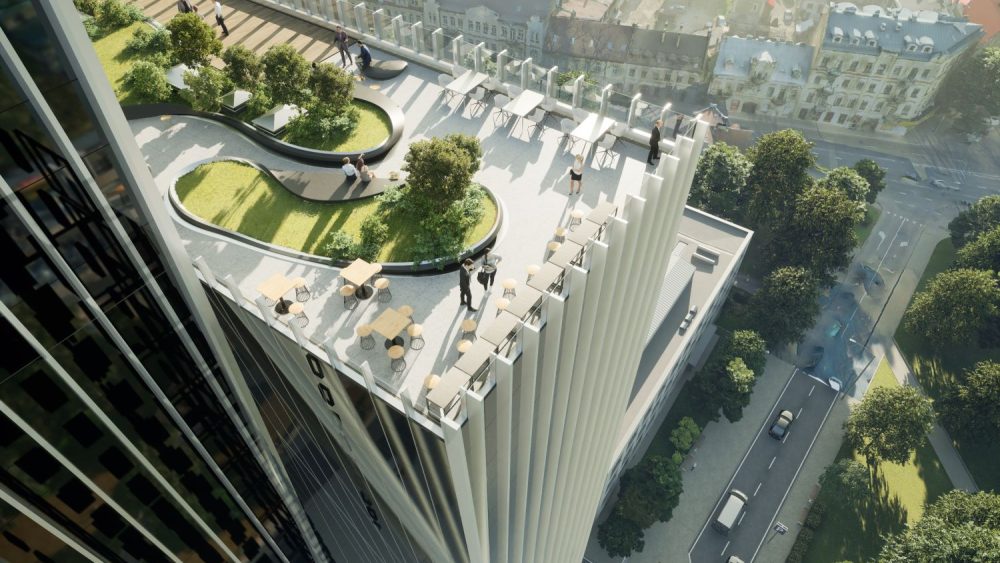
Special attention will be paid to employee well-being, relaxation, and diversification of work routines in the Flow business center currently under construction. It will feature a salt room with music and light therapy, a massage studio, a roof terrace with panoramic city views, and a multifunctional event and meeting space – an amphitheater.
“We have noticed that companies that have decided to rent an office are paying a lot of attention to the hybrid work model and, when planning the layout of the spaces, they want flexibility, dividing them into smaller offices or areas for teamwork. In addition, if necessary, we have foreseen that companies will be able to install a workplace reservation system in their office. It will ensure that employee flows are distributed evenly during hybrid work and that all employees who come to work find a free place,” says Giedrius Brūzgė, Director of the Asset Management Department of the company “Eika”, which is building the “Flow” business center.
Office spaces are more team-friendly
International studies show that about 30-45 percent of employees work in offices, with the rest working from home or other spaces. According to a workplace anthropologist, the pandemic period has also changed the view on the purpose of the office.
“Now the office is becoming a meeting place that unites the team, a kind of nucleus. Although the usual individual spaces are not disappearing anywhere, companies are increasingly leaning towards spaces that encourage collaboration. The proportions are changing, how much of the office is dedicated to workplaces and how much to spaces where you can communicate with the team or make uninterrupted long-distance calls and have a quiet conversation. After all, nobody needs empty employee desks, it is better to create spaces for teamwork instead,” says A. Žemaitė.
Before setting up spaces, a workplace anthropologist advises answering a few key questions – consider what the company does, what its employees do when they come to the office, and what is most important in order to help employees achieve their goals and feel comfortable.
“If the company is creative, then the space needs more creativity, to think about solutions that would help it spread. If the company provides legal services, their workspace priorities are different, more representativeness and privacy. A decade ago, technology companies used to set up playrooms for their employees, which may not be relevant for architects at all. So when setting up spaces, it is very important to take into account the individual needs of each company,” the workplace anthropologist has no doubts.