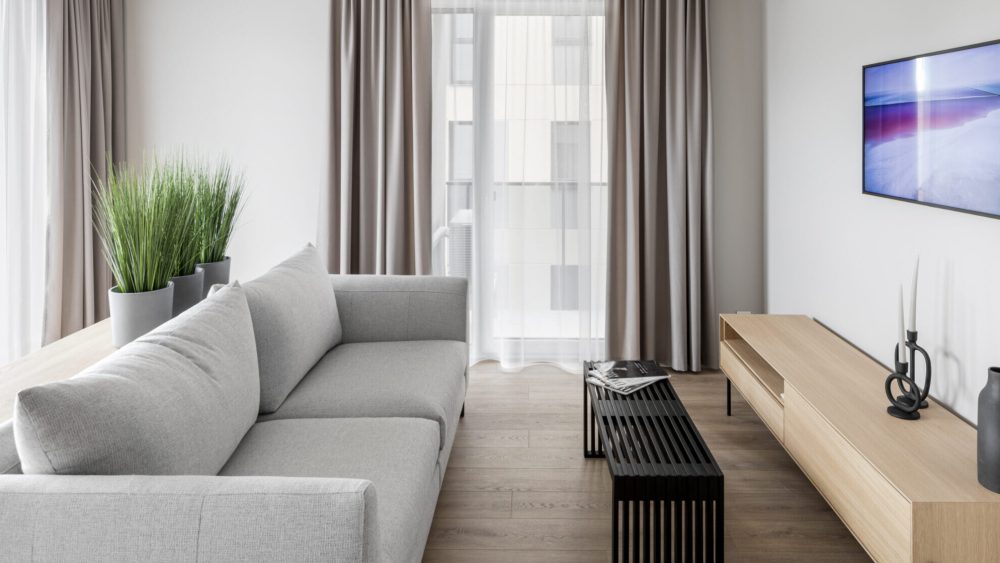
Boiling water running from the faucet so you can immediately make a cup of tea. A smart mirror in the bathroom where you can watch your favorite TV series or listen to music from YouTube. Voice-controlled lighting, a robot vacuum cleaner, a television. A virtual assistant reading the weather forecast. These are the elements of a smart apartment that will soon become, or perhaps already have become, a detail of many people’s everyday lives.
According to Dr. Artūras Serackis, professor at the Department of Electronic Systems of the Faculty of Electronics at Vilnius Tech, smart technologies make us feel like we are living in a different era than before, although in fact it is already the present.
“We feel technological progress in many places around us. Some things that once seemed to us to be the invention of the distant future or fantasy have now become commonplace. Many people around us are enthusiastically trying new technologies, new smart devices. After all, if earlier we used to choose a phone or a calling plan in the salons of mobile operators, now we choose a speakerphone, a scooter, a robot vacuum cleaner, and smart surveillance cameras,” says the professor.
According to A. Serackis, although at first glance it might seem that new technologies are more important for the households of people with many activities and little time, they can also be a good help for children and people with physical disabilities (even temporary ones).
“Imagine if you break your arm while playing sports. Everything can turn upside down, you won’t be able to open the refrigerator with the usual movement, and sometimes you would like to have smart solutions in the toilet, which are so common in Japan,” says the professor.
Installed a smart apartment in Naujamiestis
Smart technologies can be easily and economically applied in every home. This is what Eika, a company that, together with its partners, has created a model smart apartment. It is full of devices controlled by artificial intelligence and other innovations, the most innovative home appliances, and furniture made from sustainable materials, is convinced of.
“We notice that smart technologies are not yet a part of everyday life in our homes. They are used less often because people doubt their technological skills and ability to manage them. However, we believe that anyone can create a smart home. All it takes is a little curiosity, determination and a desire to make their lives more comfortable. The Eika Smart Lab smart apartment is an example of how seemingly distant technologies are available here and now, and how they can make life even more comfortable. This will be our ongoing project, to which we invite as many technological partners as possible, especially Lithuanian developers, to join,” says Domas Dargis, CEO of Eika.
In a smart apartment in the capital’s New Town, many devices are connected to a smartphone, including a virtual assistant that allows you to adjust the lighting with your voice, help you make a shopping list, listen to the weather forecast, play the desired piece of music, or check your e-mails. If smart home technologies were to be controlled by separate control panels, almost 10 of them would be needed, in this case, one smartphone or your voice is enough.
The technology in the smart apartment is also exceptional – you can cook food in the oven by selecting the latest steam function, the steam from the hob is immediately collected by the built-in hood and does not spread throughout the apartment, the smart toilet is automatically controlled, the bathroom has a TV-mirror, and using the intercom, you can see guests who have arrived on the phone screen.
Tips on how to make your apartment smarter
Experts note that making your home smarter doesn’t require a big budget or a higher engineering education. To get started, all you need is the right lighting fixtures, an additional device adapter, and a virtual assistant app.
“If you have decided to make your apartment smarter in the course of your life, I would first recommend checking what devices you have at home and whether they can be connected to the virtual assistant function. Then start by equipping one room with smart lights. Then gradually try new elements,” advises Maija Nikitina, Eika Development Project Manager and Innovation Ambassador.
According to her, in order to automatically control the lighting in a 50 sq. m apartment, an investment of 500 EUR will be enough: “Our group company “Apdailos Formatas” can help you install a smart home.”
There are devices that cannot be turned into smart devices. Then a special plug socket linked to a virtual assistant will come in handy. This way, you can ask your voice to boil water for a teapot or ask your virtual assistant to turn on the lights.
“People think it’s easier to stand up and turn on the button, even though it’s just a habit. When they start using the help of a virtual assistant or other smart technology benefits, they realize that such a life is not only more convenient, but also safer and more sustainable. Many of these smart technologies can save resources and provide preventive warnings if something happens at home,” says M. Nikitina.
The Eika Smart Lab smart apartment was developed together with partners: Grohe, Nolte Küchen Lietuva, Ekoliumenas, BTN, ISKU furniture, Stentron, Transformojami baldai, Parkis.