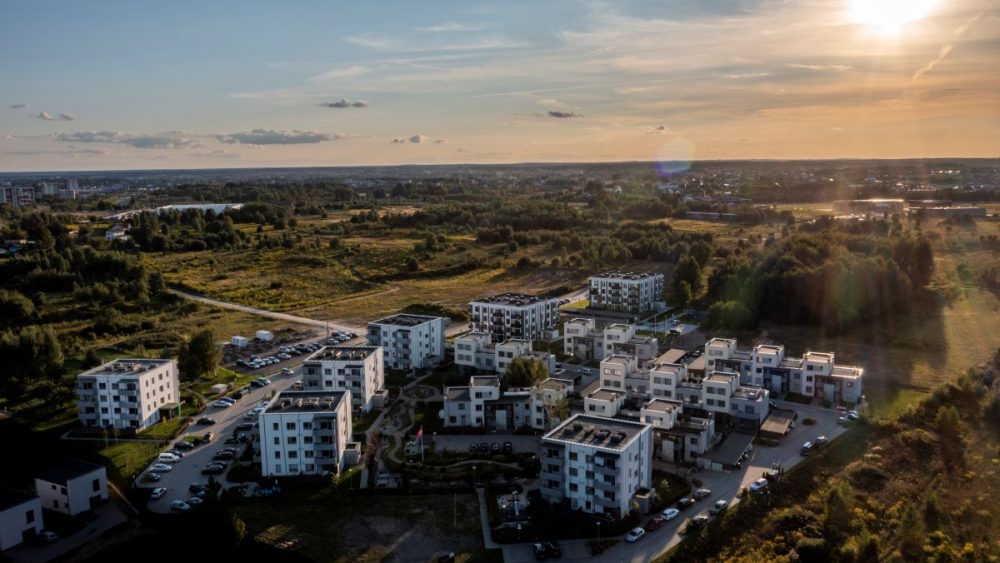
Located on the outskirts of Vilnius, Bajorai is considered one of the capital’s currently undervalued districts. It is predicted that as infrastructure expands, the aforementioned area will receive more attention not only among real estate developers, but also among buyers, especially young families..
Currently, Bajorai is dominated by low-rise individual houses, and the supply of apartments for sale in apartment buildings does not even reach 200. According to real estate experts, Bajorai is classified as one of the districts of Vilnius with the lowest population density, with not many apartment blocks, enough space to live comfortably and enjoy the tranquility provided by nature.
“Bajorai is still waiting for its hour, which will strike in the near future. The city is expanding noticeably, encompassing more and more distant districts, and Bajorai is increasingly being named among those with the greatest potential,” says Tomas Žiaugra, development manager at real estate development company Eika.
According to Tadas Jonauskis, founder of the international urban planning office Pupa, Bajorai is a developing area where one can now experience such aspects of quality life as a smaller number of neighbors, more space around apartment buildings, and a nearby forest.
Infrastructure is improving
Both developers and urban planners identify one of the main shortcomings of Bajorai as its relatively limited connectivity. However, with the start of asphalting of Mykolo Lietuvio Street, which will connect with Mokslininkų Street this year, more opportunities will open up to reach the district faster and more conveniently. Considering this step by the municipality, it is likely that the improvement of the infrastructure around Bajorai is currently one of the city’s priority plans.
According to T. Jonauskis, within the next decade, Bajorai may become an equivalent district of the capital with a full social infrastructure. “The Vilnius City Master Plan provides for development in this area. In terms of its density, distance to the city center, and social services, Bajorai may in the future somewhat resemble Pilaitė, which also naturally went through all the stages of district formation,” says the urban planner.
Real estate expert T. Žiaugra notes that Bajorai is similar to the new and family-favorite district of Lazdynėliai in terms of its distance to the city center, transportation, and concept of 3-4-story apartment blocks.
“Both districts are located on the outskirts of the city, close to the main traffic arteries: Lazdynėliai is accessible only via Oslo Street, while you can conveniently return to Bajorai either via Geležinio Vilka or Ukmergės Streets, or via the Western Bypass, bypassing the city’s congestion. Bajorai is currently more attractive due to its smaller accommodation and more spacious environment,” notes T. Žiaugra.
Recently, the range of social services in Bajorai has also been growing: the construction of the 240-place Vilnius City Municipality kindergarten “Bajorėlis” is nearing completion, and the technology town stretching along Geležinio vilko Street is expanding.
Larger apartments – for living, not for investment
According to the price level, Bajorai is classified as an economy class and could be next to the currently most popular districts of this class – Pilaitė, Fabijoniškės, as well as Lazdynėliai. Here the price fluctuates around 2.5–2.8 thousand euros per square meter.
According to T. Žiaugra, Bajorai stands out from many other districts in that the vast majority of apartments here are purchased for permanent residence, not with the hope of renting them out.
“Closer to the city center – in Žvėrynes, Vilkpėde or Šnipiškės, small apartments – up to 50 sq m on average – are prevalent, which are suitable for rent and purchased as an investment, while more than 60 sq m of space are being designed in the future Bajorai quarters. 3-4-room apartments can be integrated there. All this suggests that housing in Bajorai is mostly oriented towards young families who are looking for peace, greenery, a slower pace, opportunities to walk with pets and want to get away from the hustle and bustle of the city,” says T. Žiaugra.
As shown by the data of previous apartments sold by “Eika”, smaller apartments are also being purchased, which are chosen by older people or children offer to their parents who miss nature, silence and quality of life. Currently, “Eika” is building about 100 apartments in Bajorai, and is designing about 250 more apartments for the next 3-4 years.