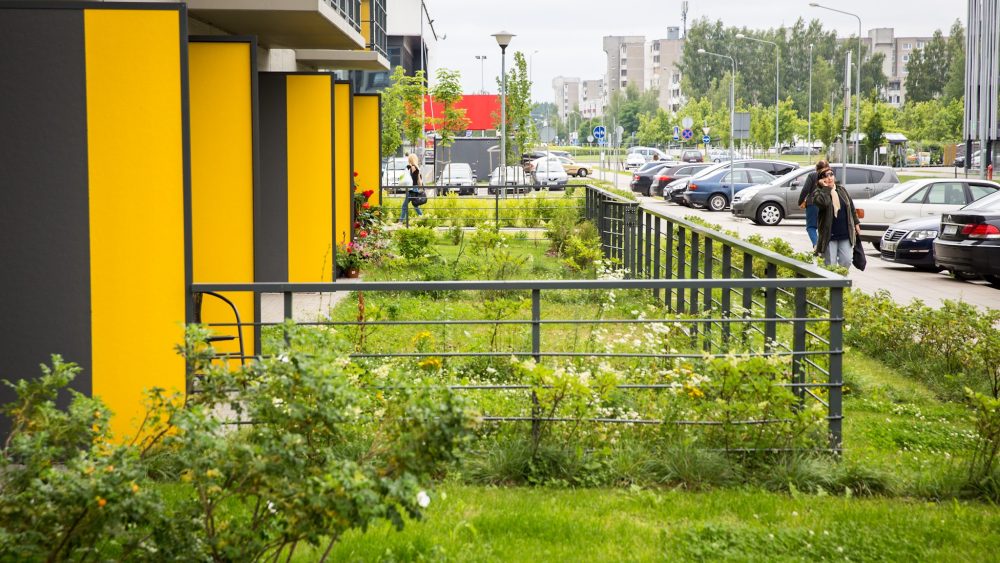
Pilaitė, Pašilaičiai, Fabijoniškės, Šiaurės miestelis, Šnipiškės. Which district of the capital is currently growing the fastest? According to real estate experts and developers, it is Pilaitė, where about 1,000 new residents settle every year. DThe district’s rapid development is not accidental – it was planned 30 years ago and currently remains one of the strategic ones. It is predicted that the development in Pilaitė may continue for more than one decade, and the population may increase significantly from the current 30 thousand..
According to urban planners, the development of Pilaitė is smooth and well-planned, unlike the new northern parts of Pašilaičiai and Fabijoniškės on Perkūnkiemis and Salomėjos Nėries streets, where everything was hastily built, there are still wrong passages, and there is a lack of clear passages between apartment buildings.
“Everything in Pilaitė is happening according to the planned and well-prepared detailed city plan. As a result, a good street network, infrastructure, and public spaces have been formed. The city center is easily accessible from Pilaitė both by public transport and by car. Pilaitė is also densely populated, which is very healthy for the city, there is good house architecture, a favorable natural environment – lakes, forests,” says Justina Muliuolytė, head of the “Pupa – Strategic Urbanism” team.
True, the specialist also sees several shortcomings, which, if corrected, could make Pilaitė an even more attractive district in the future. “Most often abroad, a district or block is formed from a public space, a district center, and Pilaitė lacks this. It is as if there is a center where shopping centers are located, but the center needs not only a commercial function, but also a public function, where people could meet and communicate. The detailed plan provides areas for this, but they are currently empty. The potential of the district has not yet been exploited,” says J. Muliuolytė.
According to the latest data from real estate developers, 493 apartments are offered for purchase in Pilaitė. 258 apartments were purchased in the first seven months of this year.
“The supply in Pilaitė is growing every year, this year alone it is planned to build almost 500 apartments. Demand is also not decreasing, because Pilaitė attracts young families planning their own and their children’s future. Most of the apartments are economy class and are one of the best choices in the capital, considering the price-quality ratio, taking into account the natural environment, the layout of the district, and communication with the center,” says Martynas Žibūda, Development Director of “Eika”.
According to Albinas Šniras, the elder of Pilaitė, the average age of people living in the microdistrict is 35-40 years old, and there are about 1,500 preschool-age children. According to the portal of the Department of Statistics, Pilaitė is one of the districts of the capital with the fewest people over 65 years old. In addition, it is one of the districts with the largest number of children under 14 years old.
“Pilaitė is growing rapidly, and the development of infrastructure is slightly lagging behind compared to the increase in population. The nearest plans include the construction of a new kindergarten and school, as there is a need for it. Trade in Pilaitė is also becoming more active, with about 150 permits issued annually. In the summer, the main products sold are fruits and vegetables, in the spring – flowers, and in the winter – Christmas trees,” says A. Šniras.
Urban planners say that according to the detailed city plan, the northern part of Pilaitė should grow rapidly. “In the mentioned territory, there is an opportunity to develop not only apartment buildings, but also cottages, residential buildings of a different typology. The diversity of buildings has a positive impact on the formation of a city or district,” says J. Muliuolytė.
A survey of buyers conducted by real estate development company Eika shows that location in the city is becoming an increasingly important criterion when looking for housing. According to the latest data, this criterion was the second most important when choosing housing, it has become even more important than the price of the housing. And the main criterion remains the quality of construction work.