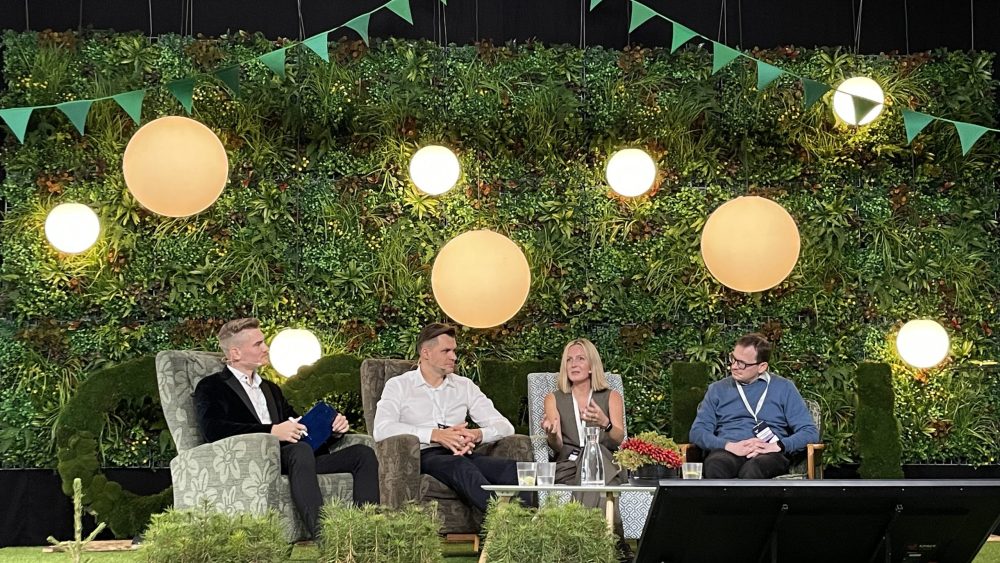
Impact Day in Tallinn is the largest festival dedicated to impact and sustainability in the Baltic and Nordic countries, and this year EIKA Group CEO Domas Dargis participated. In the discussion “Crafting sustainable urban spaces for better living”, he shared his professional experience and spoke about the still relevant challenges that need to be overcome in order to develop sustainable real estate projects.
Buildings or parts thereof can be used more than once
Following the principles of sustainability when developing real estate projects and creating an urban environment is an inevitable future, so we need to adopt this mindset as much as possible, develop appropriate technologies, and restructure the incentive system and legal framework, D. Dargis is convinced. However, for this to happen, we need to forget the attitude that we only want to build quickly and as cheaply as possible, without thinking about the long-term perspective.
D. Dargis revealed that the main principle that EIKA follows when thinking about urban spaces and real estate is to first assess what has already been created and what can be done with it.
“Whenever possible, we always adhere to the principle of preserving what is, by reorganizing, replacing individual parts of buildings, perhaps transforming them for a new purpose. Maybe the building we are in now, that is, a former factory, can be transformed into offices in the future? Or maybe it can become a hotel, an apartment building, a school or a university? I look around and think, could we make small offices on this floor, or maybe it would be better to create a space for a large audience? All these things come to mind when we design and build buildings. Our most important principle is that buildings should stand for as long as possible, because after all, they are actually built to last, like those thousand-year-old castles that we all admire,” he said.
Of course, we also have to deal with cases where renovating buildings becomes impossible when considering their alternative purpose.
“Let’s take as an example a situation where we have warehouses, and we want to turn them into a place to live. Is it possible to turn a warehouse into apartments? Probably not, because they have very deep spaces. So, we see that we cannot preserve the structure, the shape of the building. But maybe then we can preserve the materials, for example, floor slabs, columns? Floors, windows can perhaps be used for something else. Bricks can be kept, cleaned and used in a new building. In fact, when comparing the prices of old and new bricks, there is no difference – so you can be sustainable, save CO2 and not pay for it. I think everyone wants that, right?”, – D. Dargis pondered.
A more complex issue is the preservation of concrete floor slabs.
“We would like to remove the concrete slabs with a crane and reuse them in a new building. This is a more complex challenge, because they need to be inspected, checked for cracks, etc. It is difficult, but possible. The only problem is that there is nothing about this in the current legal framework – it is like a gray area. After all, these issues would be solved differently if you could get a certificate that you can reuse this material and thus save a lot of CO2. Unfortunately, for now, the certification and inspection have to be repeated again and we will have to pay extra for it,” he explained.
“We went through this process and now it will probably cost five times more than buying new materials, but we still want to do it as a pilot project, and in the future the price difference will, of course, decrease,” D. Dargis is convinced.
Giedrė Skučaitė, sustainability consultant and architect at Lendager in Denmark, also emphasized that it is important to understand that there are different categories of material reuse – sometimes they do not need to be recycled at all, just used in other ways, sometimes they need to be mixed with others, shredded and recycled, etc.
She shared the experience of the company she works for – they are one of the few in the construction sector that implements various recycled materials, and one of the biggest challenges is collecting data to truly assess the benefits or harms.
“We need to be well aware of the amount of emissions that go into recycling or recovering materials, and to assess transportation and other aspects. We also need to be smart about how we can increase the value of recycled or reused materials so that they exceed their lifespan. It is also very important to pay close attention to the materials that are used in structures when reusing materials, as this is where the largest amounts of CO2 are embodied. These heavy materials, such as concrete, steel, and glass, require the most energy to produce – so we should reuse them as much as we can,” said G. Skučaitė.
The incentive system is not geared towards sustainability
Dargis hoped that such sustainable methods of material recycling would also come to the Baltic countries, but he did not hide the fact that an unfavorable incentive system still hinders this.
“When it comes to recycling materials, the process is usually such that most construction companies and developers have absolutely no incentive to use high-quality materials that can last longer. If you participate in a tender, even a government one, for example, to build a school or a hospital, it is not said that if you use materials that will last longer, you will get better scores. In fact, it is said that the lower your price, the more chances you have of winning. That’s all,” he said.
„Bet pripažinkime, juk vadovautis tik žemiausia kaina – labai trumpalaikis mąstymas, tiesa? Turbūt iš asmeninių patirčių daugelis pastebėjote, kad įrenginiai sugenda, vos jiems pasibaigia metų ar dvejų garantija. Bet jei pradėtume galvoti, kad garantija turėtų būti 5 ar 10 metų, tai pakeistų visą pramonę, visą mąstymo būdą. Taigi, vienas tvaraus darbo nekilnojamojo turto projektuose būdas yra medžiagas perdirbti, o kitas – prailginti medžiagų eksploatavimo laiką, t.y. pernaudoti“, – dėstė D. Dargis.
Jani-Mikael Kuusisto, „The Warming Surfaces Company“ vadovas, pastebėjo, kad toks požiūris būdingas ne tik Lietuvai – su juo susiduria ir Suomija: „Vis dėlto gyvename pasaulyje, kuriame iki šiol buvo manoma, kad geriausi yra tie, kurie gamina kuo daugiau ir kuo pigiau. Tačiau laikai keičiasi ir visur matome šūkius, kad mažiau yra daugiau“.
Tvariau – ne visada brangiau
Dargis pasakojo mėgstantis ieškoti pavyzdžių, kai tvarumas nekainuoja brangiau.
„Manau, kad lengviausia iliustracija tam yra atsinaujinančioji energija: saulės, vėjo energija daugelyje pasaulio dalių yra pigiausi energijos šaltiniai. Vakar klausiausi diskusijos, kurioje vienas gamintojas pasakojo gavęs pasiūlymą dėl tvarios saulės energijos, kuris buvo pigiausias iš visų jo gautų alternatyvų, bet, kaip pats prisipažino, jam prireikė dviejų savaičių įtikinti save, jog čia nėra jokios suktybės, kad čia tikrai niekas nepaslėpta ir tvarus būdas tikrai gali būti pigiausias“, – juokėsi jis.
Tačiau toli gražu ne visais atvejais dar yra taip paprasta.
„Bet perėjimas prie tvarumo vyksta labai greitai. Todėl mums reikia naujų startuolių, mums reikia kurti naujas medžiagas ir didinti jų naudojimo mastą, kad jos būtų dar pigesnės. Taip mes palaipsniui tapsime vis tvaresni. Dabar jau matome tam tikrą pažangą medienos srityje. Pavyzdžiui, patikrinome, kad jei pastato fasadą padarysime iš medžio, jis nekainuos brangiau nei alternatyva. Taigi, ateityje galėsite statyti tvarius namus už tą pačią kainą. Ar klientai nori už tai mokėti daugiau? Ne, šiandien dar neturime tokios paklausos. Bet jei statysite tvaresnius pastatus, galėsite gauti daug geresnį bankų finansavimą“, – dar vieną priežastį vadovautis progresyviu požiūriu į tvarumą įvardino D. Dargis.
Skučaitė taip pat paragino prisiminti, kad tvarumas liečia ne tik medžiagas, bet ir socialinius kultūrinius aspektus, tai yra, bendruomenes.
„Dalijimosi praktikos, sodų ir stogų įrengimas, bendruomenių sutelkimas į tai – juk iš tiesų mums, žmonėms, neskirta būti tik viduje. Taigi, kaip dėl to, kad į pastatus integruotume lauko zonas, biologinę įvairovę?“, – kėlė klausimus ji.