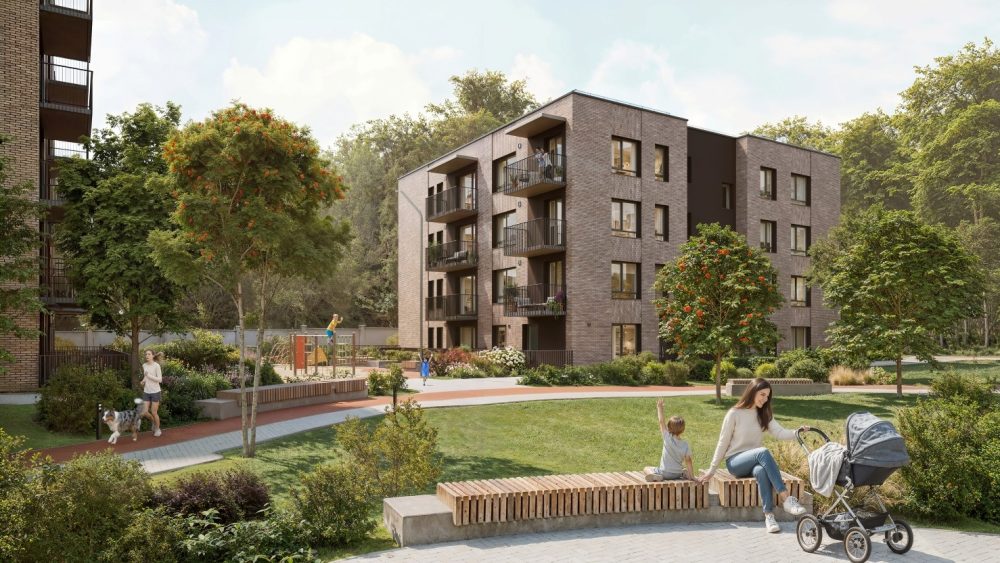
Vilnius’ housing market is increasingly shifting towards the northern part of the city. In Visoriai and Bajorai, prices have increased by almost a fifth in two years, and sales volumes have almost doubled here in a year. Experts say that this is no longer an isolated growth, but one of the most active directions of city development is taking shape, attracting both buyers and developers.
Demand is growing faster than supply
At the beginning of 2024, the average price of a new home in Visoriai was about 2,900 EUR per sq m, and in February 2026 it rose to 3,465 EUR per sq m – this represents an increase of about 19.5 percent over two years.
Sales indicators are no less telling. If in January-February 2024 Bajorai and Visoriai accounted for about 7 percent of all apartments sold in Vilnius, then this year in the same period their share increased to about 14.5 percent.
Although supply in these districts also grew – the number of vacant apartments increased from 204 to 375 (about 84 percent) over the year – demand grew even faster. Currently, these districts account for about 10.5 percent of the total supply of the Vilnius housing market, but generate a larger share of sales – about 14.5 percent.
“This shows that we are not talking about a short-term interest, but about a clearly emerging trend. Buyers are increasingly choosing the northern part of the city as a rational solution that combines price, environment and quality of life,” says Tomas Žiaugra, director of the development department of the real estate management company EIKA Development.
A new housing concentration is forming
Bajorai and Visoriai already account for about 22 percent of the total economy-class housing supply in Vilnius – a similar level to Justiniškės (about 23 percent) and more than Pašilaičiai (about 15 percent) or Viršuliškės (about 13 percent).
This distribution shows that one of the most important concentrations of new housing is forming in the northern part of the city. The activity of developers in this area is not decreasing – several projects are already on the market, and new ones are planned in the near future.
“We see that this part of the city is moving into the next stage of maturity – more and more projects are concentrated here, infrastructure is being formed, and a critical mass of residents is emerging. This naturally strengthens both demand and trust in this place,” says T. Žiaugra.
Buyers actively respond to new projects
One of the projects being developed in this part of the city is the Forest Sprint. Its first phase was launched in January of this year, with 180 apartments offered to the market. By the end of March, less than three months later, there were 77 apartments left – less than half.
Such sales rates reflect a general trend – buyers are actively responding to new offerings in this part of the city and are making decisions faster and faster.
“The results of the projects show that today, buyers are not only interested in housing, but also in a clear value proposition – location, environment, and price ratio. The northern part of the city offers this balance more and more often,” comments T. Žiaugra.
Growth remains stable
Experts predict that in the coming years this area of Vilnius will remain one of the most active in terms of both the development of new projects and the interest of buyers. The market is already seeing planned new projects and new stages of existing projects, which indicates the long-term confidence of developers in the potential of this area.
Considering current trends, the northern part of Vilnius is establishing itself as one of the main axes of the city’s development.