The process of searching for, viewing and making a final decision to purchase a home takes about two months on average, and potential buyers view about 5-7 projects, real estate experts say. However, if buyers want a larger area, are looking for more spacious terraces or balconies, or have other unique requirements, the home search can take a year or even more.
“Buyers choose one or two city districts that they find comfortable to live in. Where they would like to settle at the current stage of their lives. Then they set aside weekends and inspect all the projects being developed in the selected districts. Only after these steps does the buyer make a decision where they want to purchase a home,” Justinas Šavelskis, sales project manager at real estate development company Eika, presents the often-occurring process of buying an apartment.
Real estate specialists note that in order to decide whether to purchase a prestigious apartment in Užupis, Žvėrynes or Senamiestis, one meeting is often enough, while for an economy and middle-class apartment, which is located in Pilaitė, Bajorai or Žirmūnai, two are needed.
“Buyers of luxury housing are older, have already decided what kind of housing they want, what their priorities are, and therefore quickly make a positive or negative decision. Buyers of economy and middle-class housing first inspect the housing alone, and later arrive with an escort of their closest people – parents, relatives or friends,” says J. Šavelskis.
Children and parents have different opinions about the apartment
Buyers value their parents’ opinions the most, so they often have to change their initial decision because of them, and purchasing a home can turn into a mutual grudge.
“If buyers came to the “135” project on Žalgirio Street with their parents, I predicted that the house would not be sold. Although the children were fascinated by the house and the prospect of living near the center, their parents were unfamiliar with the hustle and bustle, the lively and dynamic street. Parents often do not listen to their children’s arguments, rely on their own point of view and would rather have them choose a house in a quieter place, for example, in Pilaitė or Bajorai. Children want their parents’ intercession, and when they do not get it, they are sometimes forced to abandon their plans,” says the real estate expert.
The Eika specialist advises you to carefully refine your opinion, evaluate it, and justify it. “No one but you will know what you like and what is comfortable for you. No one better than you will know what is needed for that stage of life,” advises J. Šavelskis.
It’s more useful to meet than to talk for a long time on the phone.
A potential buyer’s first contact with a seller is by phone or email. Experts estimate that with a quarter of customers, the first conversation takes 20 minutes or more.
“During long dialogues, potential buyers try to find out the view from the apartment window, the distance to another object, the amount of sunlight. It is difficult to explain this over the phone, so we always invite you to meet and
“To see the house in person, or if it hasn’t been built yet, to see its visualizations and talk,” says the specialist.
When choosing a home, buyers have various questions, and the main one remains the price per square meter. Having learned this, buyers ask what area of the home is possible to purchase for their estimated amount. Other relevant questions are sunlight (which side the windows will face), what kind of view through them and privacy in the apartment, i.e. will there be another house in front of the windows.
J. Šavelskis notes that the questions of buyers of prestigious housing are focused on the quality of life and comfort – will there be recuperation, convenient parking, future settlement technologies that ensure safety, and, of course, the neighborhood.
Buyers of economy and middle-class housing are more likely to have technical questions – what building materials were used in the construction, what constitutes the entire finish, what is the process of buying an apartment, how and where to get credit, how to get a larger housing loan, and whether it will be possible to get a housing loan together with a storage room and a parking space.
Virtual reality also helps in choosing
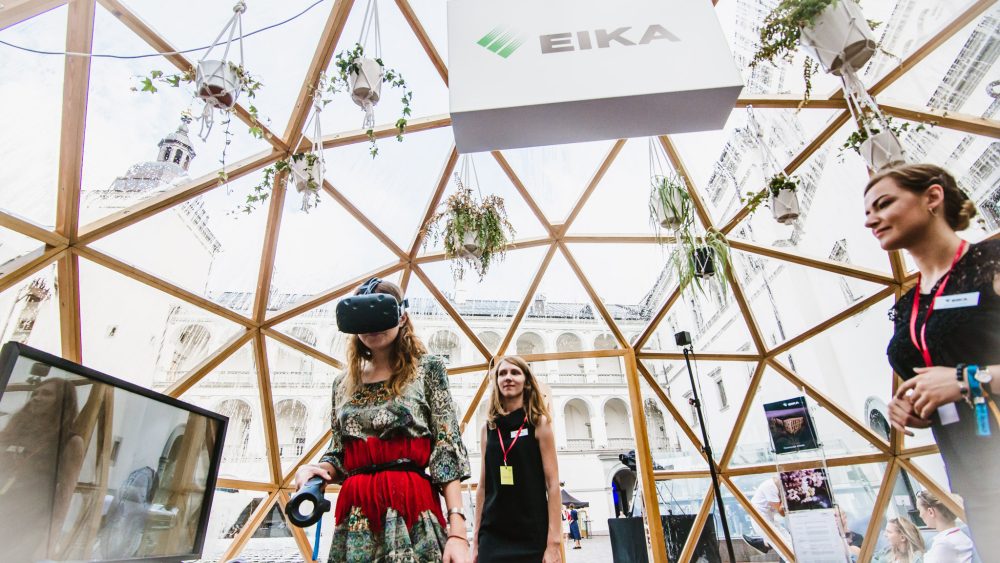
It is estimated that about 70 percent of all apartments in Eika’s development projects are sold in unbuilt homes. Previously, buyers would choose them simply by looking at drawings, but now they choose apartments using virtual reality.
“Using virtual reality, you can walk around apartment buildings or houses that are still under construction, inspect the interior of the apartment, feel its space, interior, choose colors, as well as the facade, flower beds, greenery, and children’s playgrounds,” says the sales project manager at Eika.
Virtual reality in particular helps clients imagine what luxury projects, such as LiveSquare, growing on Gedimino Avenue, will look like, and see what a shopping arcade, rooftop restaurant, and greenery will look like.