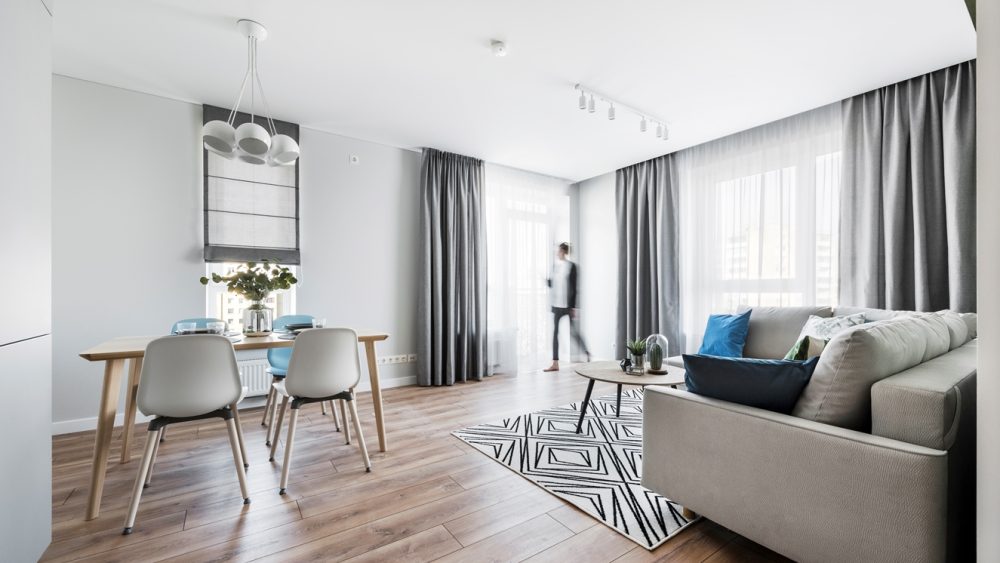
“The essence of indoor ventilation is simple – air flow in and out. If one of the parts does not work – the room is not ventilated. And air circulation can be done with a recuperation system, and other technologies or methods”, – says Robertas Grigalis, Director of the Project Management Department of the real estate development company Eika.
The specialist distinguishes four main reasons for ventilation of premises – these are carbon dioxide (CO2), which is released by people when they breathe, removal from the premises, maintaining normal indoor humidity, regulating indoor temperature, and eliminating unwanted odors.
In Lithuania, CO2 There are no regulations on the concentration limit values in residential premises, but it can be measured with a special device. The relative humidity of the air is stipulated in the official document on hygiene standards: in the cold season it should be 35–60 percent, in the warm season – 35–65 percent. It can be measured with a hygrometer.
The recommended air temperature in residential and public spaces intended for visitors is 18–22 degrees Celsius in the cold season, and 18–28 degrees Celsius in the warm season.
R. Grigalis points out that in the summer, if the home is ventilated with a recuperation system, it is advisable to use the “Bipap” function, which is available in many modern recuperation devices. When it is turned on, the outgoing air will not heat the incoming air and, for example, at night, fresh air of 12 or 15 degrees can be introduced into a room with a temperature of 26 degrees.
Advice for newcomers – don’t build on the corners of the house
It is advisable to ventilate the rooms in the same way in both summer and winter, with special attention paid to the bathroom and kitchen areas. The bathroom usually accumulates moisture, and the kitchen is always surrounded by the smell of cooking. In other areas, sudden air ventilation may not be necessary, but natural and constant air circulation is necessary.
According to R. Grigalis, inside the premises, the most attention should be paid to the corners, especially if the housing is new and the moisture has not yet disappeared from the building’s structures.
“In the first year of life in new apartments, it is natural to feel a little damp. Then you want it to be warmer and ventilate the rooms less. This creates favorable conditions for mold to accumulate. I would recommend not building blind corners in new homes in the first year, leaving free space, and constantly checking to see if the corners are clean,” advises R. Grigalis.
According to experts, improperly ventilated rooms and high humidity can not only cause mold to appear, but also cause wooden structures or their elements to deform, for example, parquet boards to begin to wobble.
“I’ve seen loose strips of wooden windows that hold the glass in place. Wood is very sensitive to moisture, so this material needs to be especially protected in both the bathroom and the kitchen,” the specialist notes.
Another common mistake that new homeowners make is installing a door with a threshold in the bathroom or not leaving enough space between the door leaf and the floor when installing the door.
Each bathroom has an air outlet. If, for example, the size of the ventilation opening or its grille is 10×15 cm (150 sq. cm), then the gap between the door leaf and the floor must also have an area of at least 150 sq. cm. So, if the length of the door leaf is 70 cm, the gap area must be at least 2.2 cm – only then will sufficient air flow into the bathroom with the bathroom door closed and its natural or mechanical removal from the bathroom room be ensured.
Recommends choosing based on sound and control
One of the most commonly used indoor ventilation systems is the heat recovery system. There are a variety of types and options available, so what criteria should be used to choose the best heat recovery system?
According to R. Grigalis, perhaps the most important thing to pay attention to is the sound emitted by the device – it can cause the greatest discomfort and annoyance, so it is necessary to assess it first.
“People also care about how the recuperation system will be controlled. For some, a control panel with three buttons that adjust the speed is enough, while others want to control everything with a smartphone. So I would advise you to take into account your technological knowledge and ease of control. Sometimes technologically educated people choose simpler control systems because after work they just want to relax and do everything more simply,” says the project management director of “Eika”.
According to him, there may be various alternatives to a recuperative air ventilation system, for example, a natural ventilation system or a mechanical ventilation system without a recuperative device. In order for these systems to work, that is, for the premises to be ventilated, it is necessary to ensure the inflow of air into these premises from the outside. Such a constant inflow is ensured by air ducts. The most important thing is that there is constant air circulation in the living quarters.