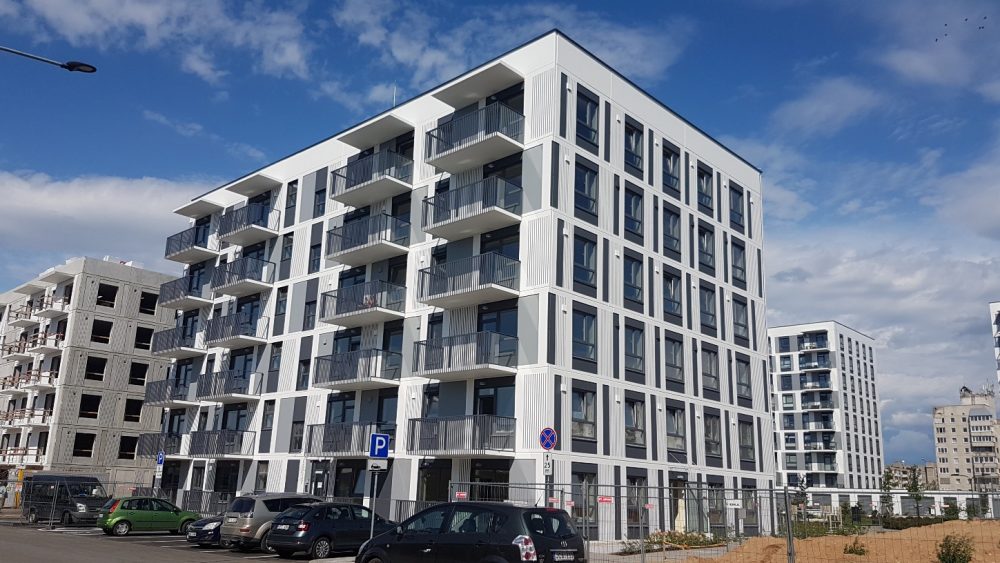
Lower costs for heating the home, better building tightness, mechanical ventilation system, less audible environmental noise. These advantages will be felt by new residents who have settled in apartment buildings with higher energy efficiency class A++, compared to class A+ or A. Housing construction specialists predict that from February 1, with the simplification of the requirements of the Technical Construction Regulation (STR) “Design and Certification of Energy Efficiency of Buildings”, the number of housing units with higher energy efficiency will increase this year.
It is estimated that this year alone, more than two dozen apartment buildings will be certified in Lithuania to meet the A++ energy efficiency class. Construction specialists suggest getting acquainted with the fundamental changes to the STR and the most important criteria for the A++ housing energy efficiency class.
After the amendments to the STR, the thermal resistance requirements for external walls of buildings of class A and higher, as well as the efficiency coefficient of the recuperative ventilation system, have been reduced.
“Before the change in STR requirements, it was possible to meet the A++ class criteria only by installing devices that produce renewable energy, i.e. solar collectors, wind turbines, etc. A heat pump alone was not enough, let alone central heating networks. Now everything is much simpler,” says Rasa Rupšytė, an energy performance certification expert at the Acoustic Research Center.
Designed as Class A, built – like A++
According to specialists, if a building was designed for class A before the previous STR requirements were changed, i.e. a couple of years or more ago, then most often now, after the building is built, it easily and without additional costs reaches class A+.
One of the first apartment buildings in Lithuania, which was designed as an A energy efficiency class, and after its construction was classified as an A++ class, is located in the Karaliaučius quarter in Pilaitė, managed by Eika.
According to Dr. Robertos Volvačiov, Construction Project Manager at Eika, when we started building a new apartment building in Pilaitė, we already knew that it would have a higher energy efficiency class than previously built houses in this quarter.
“The building was designed with thicker heat-insulating layers on the first floor floors, exterior walls, and roof, and a recuperative ventilation system is also provided. In 2019, after the STR requirements changed and additional calculations of longitudinal thermal bridges were performed, we realized that our design solutions, such as recuperators with a high efficiency factor, balcony sills, and window opening edge insulation units, could ensure the highest energy efficiency class A++ for us. After completing the building certification, we achieved this energy efficiency class for the building,” says Dr. R. Volvačiovas.
He notes that during construction, great attention was paid to ensuring the building’s tightness. “The A++ energy efficiency class has higher tightness requirements than the A class. The tightness of a specific building is determined by performing tightness measurements at the facility. “The tightness value determined during the measurements in our apartment building was even 3.5 times better than the value set for A++ buildings. This should mean lower heating costs for residents,” says the construction specialist.
Better sound insulation
The apartment building, which meets the criteria for the A++ energy class, also achieved a higher, B sound insulation class, although most apartment buildings are classified as class C.
“We had to stand out in the active market of the Pilaitė microdistrict, so we improved some building components for acoustics, for example, acoustic tightness through floor ceilings. Measurements performed by an accredited laboratory in the apartment building confirmed that we had achieved sound insulation class B. This acoustic comfort class is rated as very good or good by 70–80% of people. Apartment buildings with a higher sound insulation class – A – are not being built, because the cost of their construction would be unreasonably high, for example, it would be necessary to install inter-apartment reinforced concrete walls, the thickness of which would be about 40 cm,” says Dr. R. Volvačiovas.
According to the construction project manager at Eika, when purchasing a partially finished home, acoustics can be improved if the finishing work is carried out properly: suspended ceilings with a sound-insulating layer are installed, walls are plastered, and flooring is installed following specific technologies for performing these works. It is important not to leave any leaks through which sound could spread.