How did Cloud Architects come about?
Sometimes the place is historical, we appreciate it and try to sensitively supplement it. Sometimes the environment is a district formed during the Soviet era, which needs a new sign, a new impulse that will set the quality of further development, in which case we follow the principle of contrast. Each project is a new story, new challenges. We often hear the question – why are your buildings all so different and look like they were created by different architects? I answer that we designed them all by looking at the environment, looking for what it needs. I consider this question a huge compliment. It seems to me that there is nothing worse than the same visual model of a building repeated by an architect throughout the city, but in radically different places.
Sometimes this impression comes to mind when driving through the newly developed business districts of Vilnius. It is somewhat reminiscent of the situation in Berlin. The situation is similar with buildings by Scandinavian architects in Vilnius. International architecture is not bad, on the contrary, I think it broadens our horizons. However, when you start analyzing the color of the facades, why it is, say, strangely greenish, you suddenly realize that such a color goes perfectly with the Scandinavian oxidized copper towers and roofs, but Vilnius doesn’t have them… In Lithuania we speak Lithuanian, in Copenhagen – Danish, the same is true in architecture, we must respect our language!
What is your favorite building (in the world) and why?
I can admire buildings, they evoke emotions, but I never look for inspiration for my work in them. My head is already bursting with ideas and visions, there are no uncreative days in our studio. And the impulses for these ideas are simple everyday life, travel, and very often – discussions with friends from different specialties about political events. My ideas are born keeping a hand on the pulse of life. Every architect creates differently, it is his kitchen, in which there is no single recipe for success.
I admire architects as personalities. There is a gray creative cardinal in every studio. I have worked with Massimiliano Fuks, working in his studio gave me a lot, but even more were the subsequent meetings and conversations with the maestro over a cup of coffee. You can’t help but be amazed when you have in front of you a person who seems to fit the whole world. His work has no country boundaries, he knows many cultures, his works stand in various different parts of the world. It was during one of his visits to Lithuania that M. Fuks encouraged me not to be afraid to strive for more and go further. Therefore, the year 2020 for Cloud will be special – we will go further and our studio will be supplemented by an international office outside Lithuania. I want to keep where it will be a secret for now – but it will be a seven-mile step.

What city do you think is a good city from an architectural and urbanistic point of view?
In my opinion, a city is a complex organism that tends to shape itself, change its shape, its face. Although Vilnius is successfully developing according to the vision of the general plan, and we as architects try to look after the city, to blend into it peacefully and accurately, in one place or another of the city something strange still emerges, it is impossible to fully control it. And this is somehow fascinating. Sometimes not in a good way. But it has always been like this. We have the ensemble of St. Anne’s and Bernardine churches, which is far from reminiscent of a harmonious and respectful adaptation to the environment, bearing in mind that St. Anne’s church was, to put it mildly, built-up right in front of the Bernardine Church. However, today both churches are protected as unique values. It was the same with the Eiffel Tower in Paris. Now it is a symbol of the city, of the whole country, although it had to be dismantled after the exhibition. That’s why the latest building by Herzog & de Meuron in Paris is a giant pyramid. Why? Because it is in the background of the Eiffel Tower, and they beautifully friends.
Maybe that’s the beauty of the city?
Yes, for me, the fact that a city is a living organism, has its own character, sometimes angry, sometimes humble or stubborn, and that is beauty. Of course, it often happens that society opposes all new construction. This is understandable, after all, no one is attracted to a construction site under their living room window, especially if the future building contradicts their aesthetic understanding. An interesting fact is that society is afraid of glass, larger windows. This is reminiscent of 1696, when King William III of the United Kingdom introduced a window tax. People living in houses with more than six windows were forced to pay a quota. In order to avoid paying the tax, people chose to brick up the window openings, this was called Daylight robbery. So, light in life meant financial status. Considering modern innovations in ventilation and solar control and the fact that we do not have to pay for additional windows, it is inappropriate to be afraid of larger windows or more glass in a building. Glass is a very interesting material in itself – it reflects the environment, so the building can blend into it as camouflage. Meanwhile, working in a building with many windows is an indescribably good feeling, considering that as the pace of life increases, we spend more and more time at work. The transparency of facades helps not to be detached from the environment, to see how the sun moves outside the window, how the seasons change. Therefore, people’s opinions are often very subjective, sometimes even irrational.
What places in Vilnius do you like the most from an architectural point of view, and why?
I like all of Vilnius, unconditionally with its flaws and sore spots, so I couldn’t single out one place. Apparently, that’s what love is. I’ve lived in many districts. I’m very happy when some place recovers, is being developed. I’m very happy that the New Town is slowly coming back to life, conversions of factory territories are taking place, I’m happy that everyone is trying to respect and protect the Old Town. Unfortunately, this is not love without an expiration date, even the best conservation of buildings has expiration dates. I’m happy that the municipality is currently working a lot for the good of the city, encouraging the creation of public facilities, maintaining squares and embankments.
However, by simply fixing the embankments, we solve only part of the problem, although it is a very important one. Vilnius has such a fantastic natural formation as a river at its heart, I think it should be used better. The riverbed is clogged in places to the point that leisure transport cannot fully develop there. The river is an attraction in itself, but it needs help.
In your opinion, what is special about the Vytautas 35 district – Žvėrynas?
The zoo is beautiful because it is located in the heart of Vilnius, but not in the Old Town or the center, and at the same time it is very green. The zoo has a unique connection with Vingis Park. The ancient perimeter possession street construction used to dominate here. I say previously, because, although there are still many motifs of perimeter building on Vytautas Street, in the rest of Žvėrynas we see less and less of the historical past and contextual adaptation. It is sad for Žvėrynas. A colleague has aptly observed that The menagerie became a zoo. The zoo, according to its name, is supposed to be home to animals from the Lithuanian forest: deer, foxes, wild boars. And the zoo has various animals: giraffes, elephants, from South America and Africa. The uncontrolled construction of individual houses in 1990–1995 left a scar on the main streets of Žvėrynas. It is unlikely that many would have appreciated the architecture and historical heritage of the place. You can tell which period each house is from, just by the fashion in architecture and the choice of materials at that time. All this became obsolete quickly, in just a decade.

What is the concept of “Vytautas 35”, how did you incorporate this building into Žvėrynas?
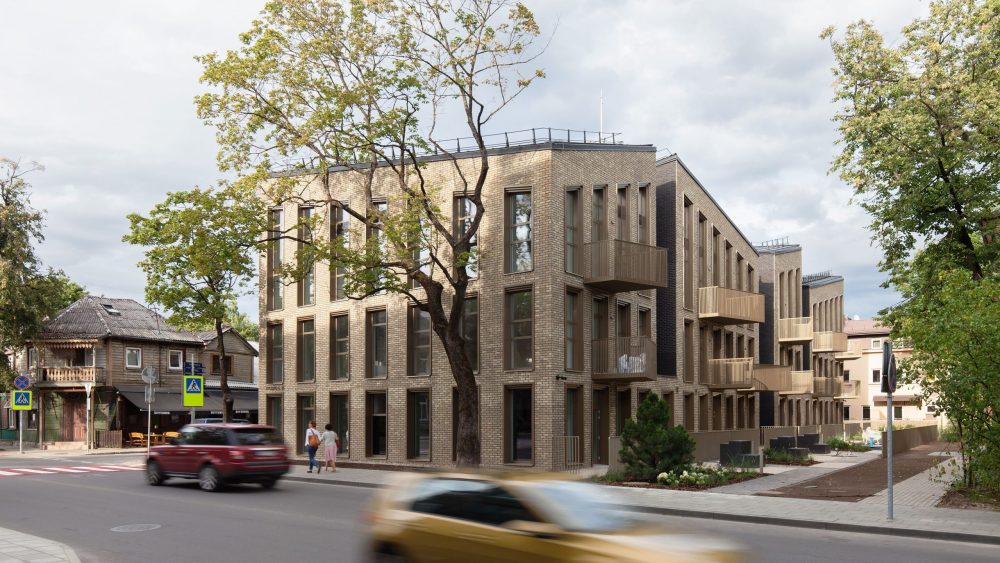
We could have built the building in any color – steel or black, but then we would have only added zoo with another exotic animal. However, today, when the construction is already completed, there is nothing more beautiful for me than looking from the corner of the old pharmacy in Žvėrynas and seeing how the yellow brick facade of “Vytautas 35” merges with the neighboring yellow brick house, how the silhouette of the building does not protrude or stand out anywhere. This place does not need another exotic bird, there are already so many of them here. I am not saying that the old ones need to be rebuilt baroque, but you need to observe and feel the environment. You need to build transitional connections between what was and what will be. When we get a challenge to design a new building, we first go to the site and walk around the area for a very long time and many times, looking at the general view, what dominates, what are the details of the surrounding historically valuable houses: how the window strips run, how the windows are grouped, what the window frames of brick buildings used to be, what materials, colors.
The old yellow brick buildings of Žvėrynas are charming with their facade decoration that transitions into volumetric ornamentation. Brick does not age, it only becomes more beautiful with age, while the volumetric ornaments formed from the same bricks on the facade catch sunlight every day and look different every hour, because their shadow moves, the other side is illuminated. This is also important in the idea of ”Vytautas 35″, the windows are like picture frames. The volumetric frames are only on one side and top of the window, creating an image as if you were looking at the Old Town or Žvėrynas building from the side, and from the window edges, as the light changes, a subtle flicker of shadow would be visible across the entire facade. Nothing fancy, just volumetric elements that cast a shadow. Because colors… they fade and change, and one thing that remains the same all the time is the sun, always rising in the East and setting in the West. So the edges catch different reflections of the sun and cast different shadows at different times of the day, making the house seem to be vibrating. The facade looks sensitive. We are very happy with this solution, the building looks as if it has been here.
How was the building’s silhouette born?
In that place, in Žvėrynas, designing non-pitched roofs would have been a crime. So pitched roofs were already part of the task. Another part is the old brick architecture of Žvėrynas. This is the answer to how Cloud architects imagine a modern inclusion in Žvėrynas in the 21st century without damaging its valuable features.
Both EIKOS and our initiative contributed a lot to the volume of the building. It was a very timely and useful relationship with the community, it is good that it was a fairly early stage, the community expressed a request that the already small volume be further reduced, from three volumes there were four. I think that this was one of the most successful examples of working with the community, when the result satisfies both parties and happens smoothly, with respect. It was in this particular place that they did not want to stand out, because Žvėrynas is already so colorful, people are colorful, everything is colorful. The city would not thank you for that.
What did you learn in this project?
Since we have been working with the residents of Žvėrynas, as soon as we have the first sketch, we immediately invite the local community, even before the official publicity procedures have started, we go to meet, talk about our vision, what theirs is, what the regulations are, what the infrastructure will be, how the new building will improve the situation. At first, local residents are often shocked that something will change in their territory, but when we solve issues together, there is always a good result. We have pleasant conversations with our neighbors at Vytauto 35 and now. I go into the old pharmacy, I get compliments on how beautiful the building turned out, every day after work I inspect the construction work done during the day, we talk with our neighbors by the fence about life and about Žvėrynas, about flowers, I tell them what plants we are planting in the project territory, what a beautiful overall view it will have. It turns out that for a successful new architectural integration, it is not enough to know only the surrounding buildings and the historical urban development of the territory – you need to know the entire surrounding environment, which includes people. Lithuanians really need to communicate more and more sincerely, and then everything will be fine, not only in life, but also in architecture.

More about the project: https://vytauto35.lt/