As European cities grow rapidly, real estate (RE) developers and architects are increasingly focusing on the renewal of urban spaces. Old industrial buildings are being transformed into offices or residential spaces, factories are gradually moving from city centers to suburbs or even further, making way for the needs of city dwellers and at the same time solving various pollution problems. Such changes in Lithuania are also no exception, but, according to experts, they are still too rare and happening too slowly.
Urban spaces are being returned to citizens
Speaking about Vilnius, Martynas Žibūda, head of the real estate project management company EIKA Development, believes that city centers and their surrounding areas are very attractive both because of their location and developed infrastructure. Therefore, according to M. Žibūda, it is better to allocate urban, especially old industrial areas, for residential, commercial or service development: “By moving the factory and returning such spaces to the city and its citizens, we make the city more comfortable to live in. In an urbanistic sense, it becomes more efficient – we can accommodate more people, the infrastructure becomes more convenient, and the city opens up.”
Žibūda notes that the real estate market is already full of examples of conversion of industrial buildings, such as the Dūmų and Betono fabrikai factories in Vilnius, the Paupis district instead of the former Skaiteks factory, or the Sparta factory, which has become a technology town and business center. According to the interviewee, such spaces are truly unique, filling not very popular parts of the city with life: “For example, the relocation of the Sparta factory is the creation of a modern space in place of an old, Soviet-era factory, which brought Naujamiestis even closer to the city center. This is a place that has become open not only to those working in the city center, but also to those living nearby. Šiaurės miestelis is another major conversion that has become truly successful.
Chooses not only suburbs, but also regions
Andrius Kamičaitis, an architect at the architectural studio “Aketuri Architektai”, points out that companies are often choosing to move factory buildings not only from city centers, but also to further regions of Lithuania: “When it comes to such projects, it would be worth first defining what we consider to be the countryside – sometimes it can be just a more remote part of the city, sometimes a completely different place. For example, “Teltonika” opened its new branch in Molėtai – thus breathing life into the entire region. As far as I know, “Teltonika” CEO Arvydas Paukštys chose Molėtai for sentimental reasons – he is from there. By the way, it is also safer for companies like “Teltonika” to open branches in different parts of the country – it is a kind of risk management.”
The architect notes that there are more businesses moving factories to the region. For example, furniture manufacturer Narbutas decided to build its factory in the Ukmergė district, thus becoming a new employer in the region. Especially since the state is also helping businesses solve emerging infrastructure challenges, such as the necessary new road section.
An old business can turn into a new one
According to M. Žibūda, the head of EIKA Development, in order for Lithuania to have more conversion projects, it would be necessary to consolidate abandoned buildings and territories of factories that are no longer in operation. For example, garage complexes in cities also have great potential for effective change, but they have many owners, which is why problems arise – how to agree on how to acquire or sell such territories or buildings, and finally – how to build new projects in them: “It is programmed that the condition of such territories and their premises will only worsen, therefore, in order for change to occur, perhaps a more significant state incentive or involvement of municipalities could arise so that such territories are renovated faster.”
When asked about the payback of such projects, M. Žibūda assures that by selling an old factory in the city and building a new one outside the city, the company’s operations are made more efficient – a newer, more sustainable factory emerges. Or, the old factory can be left unsold, but by using a real estate asset manager and partner to start developing a new real estate project on the same plot – the old factory plot can be turned into a real estate business.
Žibūda says that conversion projects are inevitable. As the city grows, we will increasingly have to look for new solutions to adapt existing territories to the needs of the city’s residents: “In our activities, we can also highlight several successful examples of conversion – a new apartment block “Namų pynės” has grown in place of the former “Vilniaus duona” combine in Žirmūnai. In the new town, the abandoned buildings of the former cigarette factory “Zefyras” have been turned into the residential block “Baltas Lapas”, and in place of the former warehouses, another block of new apartments has appeared on Šv. Stepono Street, along with co-living “Solo society” project.
Trends in Europe – inspiring
Architect A. Kamičaitis also mentions successful examples of conversion abroad, such as in Denmark, which addresses the relocation of industrial areas outside the city in a rather complex way: “We could take Copenhagen as an example – cooperation between real estate developers, the city and its port or other companies. Currently, the project of moving the port out of the city is being developed in great detail – a new residential area, Nordhavn, is being built in the former industrial area of the port, from which the center of Copenhagen can be reached in just 15 minutes by metro.”
“In addition, the district reclaimed from the port is planned with the future in mind – the metro lines are arranged in such a way that as the district grows, the metro can also be expanded. Moving the port out of the city center is something that Klaipėda should also consider.”
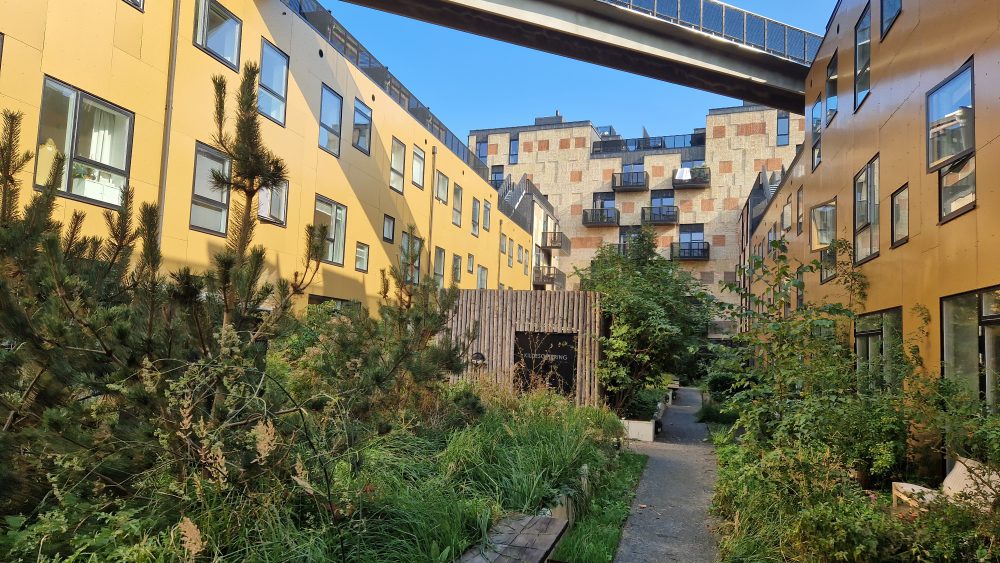
Not only can a factory be moved out of the city, but its former structures can also be used to build new buildings. According to the architect, one such example is in Copenhagen, where the old Carlsberg factory structures have been reused to build residential buildings.
Although Scandinavia pays a lot of attention to such conversion projects, there are examples to follow elsewhere – for example, the old Brussels train station has become an office and retail space, which also hosts various events that bring together citizens, or the LX Factory complex in Lisbon, which previously produced cables and textiles, and is now being transformed into a series of shops, restaurants, and offices.
“I think that such projects have already gained momentum abroad, in my opinion, there are still too few of them in Lithuania, so it would be difficult to assess them. Perhaps the most complex conversion project is the reborn Paupys, Šiaurės miestelis or the Markučiai transformation, where a whole new district is emerging,” says A. Kamičaitis.
The architect is convinced that the need to move factories outside the city center and return such spaces to city residents will only increase in the future – as cities grow, they will become denser, so both architects and real estate developers will strive to create spaces that are not only innovative and sustainable, but also meet people’s daily and social needs.