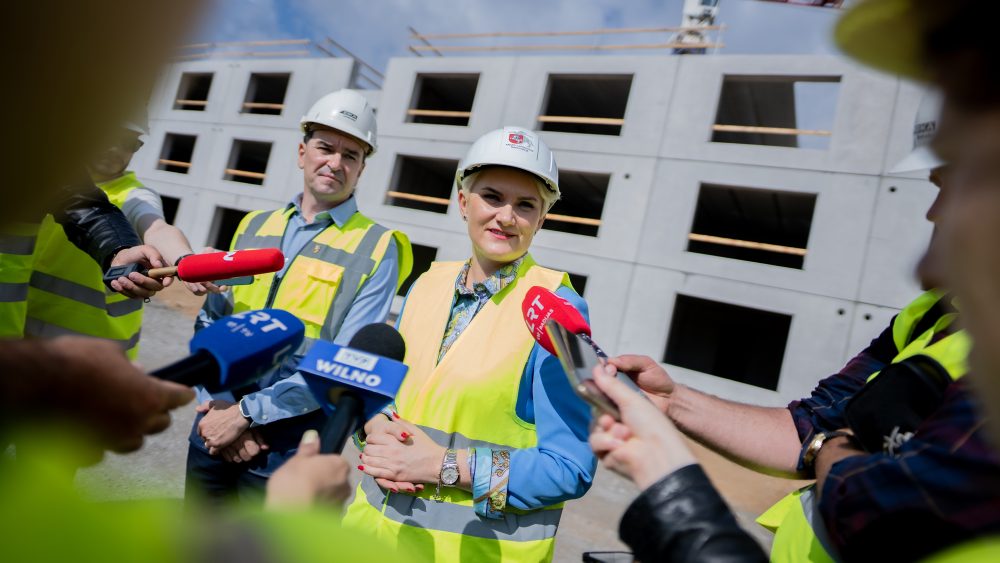
As the initial developers of the Rūdninkai training ground and military town announce their intentions to complete the first works on the development of this territory earlier than planned, the Ministry of National Defense (MND) says it will make efforts to select companies for further construction more quickly.
The company “Eika Construction” (formerly “Eikos statyba”), which is implementing the first phase of construction at the polygon for 125 million euros, says it intends to complete it half a year earlier than planned.
At the time, the second phase, which will be conducted using the public-private partnership (PPP) model, was intended to select companies and sign contracts by the end of the year, but Deputy Minister of National Defense Orijana Mašalė states that if business is willing, this deadline can be accelerated.
She presented the progress of the project to journalists at the Rūdninkai training ground in the Šalčininkai district on Tuesday.
“Negotiations, like tango, are danced by two. This is where, if we don’t have any legal disputes from the business side, if the business comes to the negotiations properly prepared – yes, we are already working day and night, our procurement committee is working day and night, respectively, to be properly prepared for those negotiations,” said O. Mašalė.
“I won’t hide it, even the ambition to have a contract by the end of the year is already very high. So if we succeed a little earlier, it will be another piece of good news for this project,” she added.
The second phase of the Rūdninkai military town development is divided into three parts. The construction cost of one part will amount to approximately EUR 400 million, and the total state obligations may amount to approximately EUR 1.8 billion (including VAT).
BNS reported that the second-stage competition ended in early June, but the ministry did not disclose how many applications it received. One company will be able to participate in no more than two of the three parts of the project.
O. Mašalė said that the ministry is already completing the evaluation of all submitted documents, which total approximately 14 thousand pages.
“That evaluation process is coming to an end, and comments are already being provided to companies so that they can provide certain information, correct something, which may be certain technical errors, and so on. And we hope to start that phase of negotiations in July,” the vice minister said.
According to her, negotiations with potential contractors are divided into three parts – technical, legal, and financial.
“Can something be done faster than business would like? It is certainly possible, as long as we are all in the right mood and looking for the best solution for the state of Lithuania,” said O. Mašalė.
Hopes that Lithuanians will be allowed to train in Rūdninkai
As BNS reported, the Rūdninkai military town, which is important for German forces, is being built approximately one and a half kilometers from the Rūdninkai settlement, and the project is expected to be implemented by 2027.
Berlin is committed to deploying a brigade of soldiers in Lithuania by the end of 2027.
O. Mašalė said that there are discussions that the Rūdninkai training ground could host exercises for both Lithuania and all other allies, although only the Germans plan to live here.
“We are coordinating so that all allies, including our soldiers, can train. However, this is a project primarily intended for the German brigade and is still a subject of discussions and conversations, but we would like as many of our soldiers as possible to train here,” the vice minister said.
“But naturally, when international exercises are taking place, we will see uniforms from all countries here. (…) This will be the largest training ground in Lithuania and we have no doubt that our German partners will provide the opportunity for soldiers from any NATO country to train here,” she added.
According to O. Mašalė, it is expected that live fire exercises will be able to be held at the Rūdninkai training ground by the end of this year or the beginning of next year.
The first phase, implemented by Eika Construction, will see the construction of part of the infrastructure of the future military town, allowing part of the German brigade to settle before the entire town is completed. This phase is also developing shooting ranges, which will allow training at the range before 2027.
O. Mašalė said that the first stage’s “progress is better than we expected”: “Here is such beautiful proof of what happens when the state and business work together.”
Eika Construction Director Almantas Čebanauskas reiterated that the company intends to complete the first phase of work half a year earlier than planned.
According to him, one of the biggest challenges of the project is the pace and changing requirements during the work.
“This is where we sometimes joke with our colleagues, we drive on the highway at 140 kilometers per hour (BNS), something else changes and then we need to keep the car on that road together with the customer, because in reality (…) in 11 months, it is impossible to design and start construction, it is practically impossible to carry out the work in such a way that it goes sequentially – I did one thing, then another. Everything goes in parallel,” A. Čebanauskas told reporters at the Rūdninkai training ground on Wednesday.
“The biggest challenges, however, are certain specific requirements, (…) however, needs also change. Not fundamentally, but there are changes, so you need to be able to respond to them,” he added.
Military infrastructure – for 4 billion euros
Currently, about 200 military infrastructure projects are being developed throughout Lithuania, and their total value will reach about 4 billion euros over the next four years.
According to O. Mašalė, the projects include construction in Rūdninkai, Šiauliai Air Base and elsewhere. Military logistics facilities are also being built throughout the country.
“There are even a lot of fences that we need to build to ensure, for example, the safety of military equipment. There are very, very many of those projects and they are very different,” said the deputy minister.
In order to manage the abundance of projects, the Infrastructure Management Agency (IVA), responsible for the development of military infrastructure, is currently being restructured.
„Čia norime sutelkti vadybininkus profesionalus, kurie, žinoma, daugiausia turi statybos, inžinerijos, projektų valdymo žinių. Bet lygiai taip pat svarbu mums yra ekspertai, kurie išmano viešuosius pirkimus, kurie išmano teisę, kurie išmano finansus. Galų gale, čia dirbs žmonės, kurie dirba su skaidrumo užtikrinimu, nes tai irgi yra ne mažiau svarbus aspektas“, – sakė O. Mašalė.
Pasak jos, planuojama, kad per artimiausius aštuonis-devynis mėnesius IVA personalas išaugs nuo 80 iki 140 žmonių, įstaiga reorganizuota, jos biudžetas sieks apie 11 mln. eurų per metus.
„Atsiranda, pavyzdžiui, tokie strateginiai departamentai, skyriai, kur yra dedikuoti tik Vokietijos brigados projektams, kurie dedikuoti tik Lietuvos nacionalinės divizijos projektams ir kurie dedikuoti tik elektroninėms apsaugos sistemoms, nes čia irgi dar yra ne mažiau svarbu užtikrinti apsaugą tokių pastatų. Žodžiu, yra tokia didžiulė reforma“, – kalbėjo krašto apsaugos viceministrė.
BNS rašė, kad gynybos finansavimą didinanti Lietuva investuoja ne tik į vokiečių ir kitų sąjungininkų priėmimą, bet ir savo kariuomenės plėtrą.
Iki 2030 metų kariuomenėje planuojama išvystyti diviziją, tam pirmą kartą nepriklausomybę atkūrusios Lietuvos istorijoje bus įsigyti tankai, taip pat kita sunkioji technika.
2026-2030 metais Lietuvos gynybos finansavimas turėtų pasiekti apie 5-6 proc. bendrojo vidaus produkto.
Šaltinis: BNS. Autoriai: Paulius Perminas, Saulius Jakučionis.