At the beginning of 2025, no new project openings were recorded in the commercial real estate (CR) market, but the sector is demonstrating active internal dynamics and is preparing for changes in the second half of the year. The main attention is now focused on the office segment, where the vacancy rate in class A projects has slightly increased, and a slight recovery is observed in class B. EIKA Development experts say that the market still belongs to tenants, and competitive pressure between business centers has taken on even more pronounced forms.
Vilnius office market is preparing for changes
According to data from real estate development company EIKA Development, the Class A office segment in the capital was stable – no new business center openings were recorded at the beginning of the year. The vacancy rate for Class A offices reached 6.3 percent, having increased by 0.9 percent since the end of last year.
However, the pace of development remains one of the fastest in the region – the area of Class A offices in Vilnius from 2018 to 2025. per year grows by an average of 14.2 percent. or 53.3 thousand sq. m. Currently, the total area of Class A offices in the city is more than 538 thousand sq. m. In addition, several more large projects are expected to be completed by the end of the year.
“New class A projects under construction, such as “Šv. Jokūbo”, “Hero”, “Jasinskio2”, “Business Stadium Central” and “Sąvaržėlė”, can fundamentally redraw the map of the capital’s offices. Together, these objects account for 80.2 thousand sq. m. of area. Although some of the new projects have already managed to attract large tenants, 63 percent of their total area is still vacant,” says Giedrius Brūzgė, Director of the Property Management Department at EIKA Development.
At that time, business centers in the premium (A+) office segment were able to significantly reduce their vacancies.
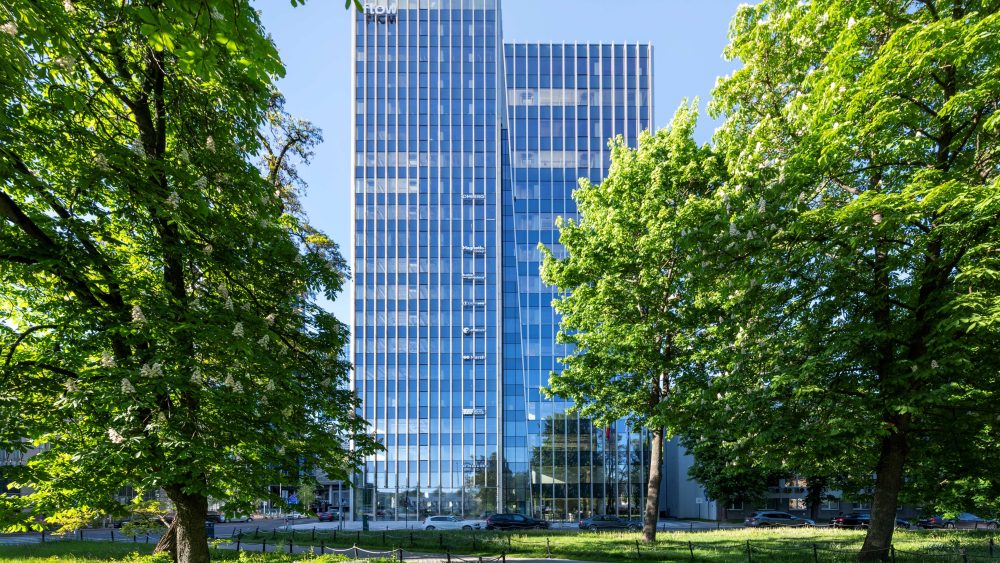
“Since the beginning of the year, the occupancy rate at the Flow business center we manage has exceeded 90 percent. Vacancy has been significantly reduced by new contracts signed, and the Flow community is growing rapidly, some of which have already moved in at the beginning of this year or are planning to move in in the second half of this year. We are pleased to see how businesses from different fields are creating a lively, dynamic environment where cooperation is established and new partnerships are formed,” says G. Brūzgė.
According to EIKA Development, the vacancy rate for Class B offices decreased by 0.8 percent at the beginning of the year to 9.5 percent. According to G. Brūzgė, this was influenced by several larger transactions, as well as tenant relocations and the strategies applied by the landlords themselves. For example, the plan to equip smaller offices and lease them to small tenants worked out for the Yellowstone business center, while Sand Offices attracted a large tenant, Circle K.
However, the vacancy rate of newly developed B+ class offices, according to the expert, remains high – about 30 percent. “This shows clear competition between projects, most of which have not even been opened yet. Tech Zity Lilium is currently demonstrating great potential, with vacancy rates decreasing after the signing of a large-scale contract. However, we are expecting changes in the segment, which will certainly be brought about by the completion of new projects,” says G. Brūzgė.
At the beginning of the year, no changes in rental prices were recorded in the Vilnius market. In class A, rental prices continued to fluctuate between 16–20 Eur/sq m, in classes B and B+ – 12–16 Eur/sq m. However, the real price of the majority of transactions is reduced by various added values provided to tenants.
The situation is more stable in Kaunas and Klaipėda
Meanwhile, the situation in the Kaunas and Klaipėda office markets remains stable. According to EIKA Development, the total vacancy rate in Kaunas at the beginning of the year reached 6 percent, while in Klaipėda it was just 1.5 percent.
Office rental prices in these cities also changed slightly compared to last year. In Kaunas, the average rental price in class A business centers at the beginning of the year was 17 EUR/sq m, in class B offices – 11 EUR/sq m, and in Klaipėda, 15 and 11 EUR per sq m, respectively.
However, G. Brūzgė emphasizes that the construction of new objects and the conclusion of transactions in both Kaunas and Klaipėda is proceeding much more slowly than in the capital.
“Although the vacancy rate remains relatively stable, conversion into new transactions is not happening so quickly in Kaunas. Businesses are actively interested in rental opportunities, but are in no hurry to sign long-term contracts. Due to the smaller market, the development of commercial real estate in Klaipėda is also taking place at a slower pace. True, several new objects are planned for 2025–2026, which should bring more dynamics to the Kaunas and Klaipėda markets,” believes the representative of EIKA Development.
The general trends in the office market in the country remain similar to last year: new projects are planned selectively, only with preliminary lease agreements for a significant part of the space. And the public sector is moving to more sustainable, new premises that meet the modern needs of employees.
“The situation of the business centers we manage, in the general context, is not very bad. Having reduced the vacancy of “Flow” at the beginning of the year, we plan to continue increasing the leased area of the building. We are also continuing to reduce the vacancy of “Jasinskio2″, which now reaches 28 percent,” says G. Brūzgė.
Trade and logistics center markets
According to EIKA Development, the growth of domestic consumption and retail turnover in the shopping center sector in 2025 is forecasted to be around 4–5 percent. However, instead of new development objects, most shopping chains tend to renovate existing locations.
“Retail parks are also becoming increasingly popular, while traditional shopping centers, adapting to changing consumer needs and market trends, are carrying out reconstructions and reviewing segments and concepts,” says G. Brūzgė.
At the same time, there is a certain stagnation in the logistics market in terms of employment, both in new logistics centers and in older buildings.
“Geopolitical tensions have also reduced the activity of foreign investors across the commercial market. On the other hand, this provides an opportunity for local developers,” shares the insights of the director of the asset management department at EIKA Development.