It is not only how many people work in it or what projects it implements that tells a lot about an organization. Often, people who decide to come back after leaving are our evaluation.
Employee turnover is a natural part of any growing organization. Circumstances change in people’s lives, place of residence, family plans, professional priorities change. Sometimes you want to try a different sector, a different specialization, a different pace of work. This is normal. For a mature organization, the most important thing is not to try to “retain a person at any cost”, but to create such a relationship that even after leaving, the door is not closed.
In international HR practice, such employees are called “boomerang employees” – they are people who leave the organization, gain experience elsewhere and later return to their former workplace. This phenomenon has become more relevant in recent years, as the labor market is changing: employees are bolder in looking for the most suitable environment for them, and organizations are increasingly realizing that former employees can perfectly continue their careers after a break.
This has a number of advantages. Returning employees already know the organization, even if it has changed a little, and they also bring new external experience with them. They already understand the company’s culture, processes, team dynamics, but at the same time they have seen how work is done elsewhere. Such a combination can be very valuable for the organization – a person gets involved faster, starts creating a result faster and often returns with new competences, knowledge, and a clearer understanding of why he chooses this particular team.
At EIKA Construction, we have such returns all the time. If a person left because of changed life circumstances, professional curiosity, the desire to grow or try a different direction – this is not a reason to burn bridges. On the contrary, sometimes leaving allows you to better see what you had, what you lacked and where you really want to realize yourself.
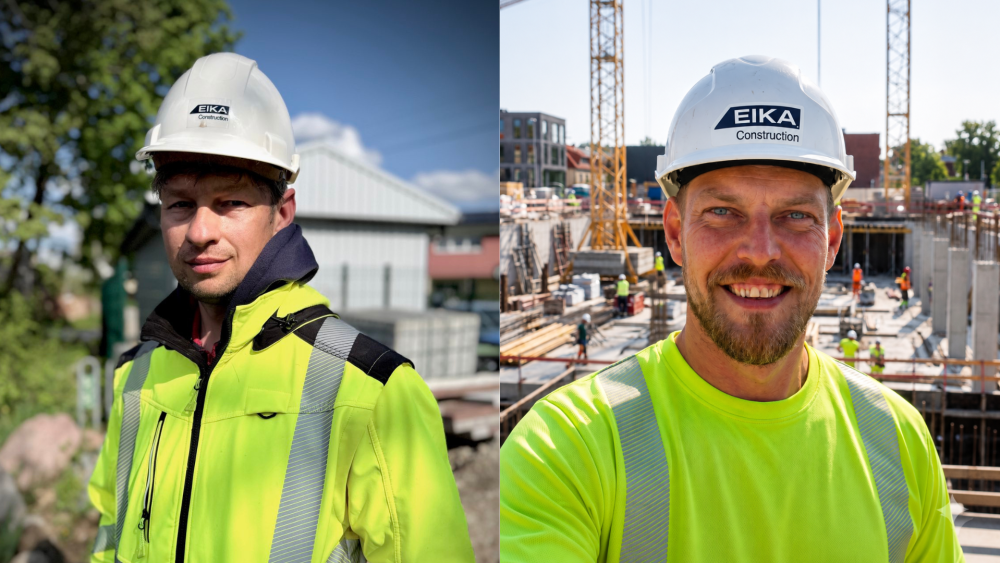
We want to share real examples:
Raimondas Pikel, construction manager of the structure, says that the team, the support of the managers and the work culture encouraged the return.
According to Raimondo, the strength of EIKA Construction is not only professional competence, but also the way the team is formed. According to him, when selecting people, it is important not only how many “medals” a person has in their CV, but also personal qualities, the ability to work together, take responsibility and maintain a good microclimate.
Raimondas also believes that motivation at work is not only about salary or material benefits. It is important to him that even in a stressful construction environment, the support, trust and timely communication of managers remain. There is no lack of tension in construction – many things change, not everything always goes according to plan, decisions have to be made quickly. But, he said, healthy tension on the pitch doesn’t have to translate into unhealthy tension in the team.
Flexibility, the ability to influence processes, and the absence of a situation where decisions are simply “dropped down from above” are also important to him. Raimondas emphasizes that what is important here is not accusations or shifting of responsibility to each other, but help and joint search for solutions.
“This is what prompted me to come back, because there are few companies that have and create such values,” says Raimonds.
Martynas Rimeisis, the construction manager of the building, returned after a conversation about the company’s changes, future plans and the opportunity to contribute to projects important to Lithuania.
Martynas says that he has already returned with a much larger baggage of knowledge and experience. However, the feeling of returning was very natural – as if he had not even left. Familiar colleagues, a friendly environment and a general feeling that the team has maintained its core values allowed for a quick re-engagement.
Not only the job offer itself is important to him, but also the direction of the company. Martynas emphasizes that the most motivating thing is the shared vision of the future, which both managers and colleagues see in a similar way. Also – the challenges that, as the company grew, did not decrease over time, but became even bigger. But, he says, when you have a strong team, even big challenges don’t seem insurmountable.
“I came back with much more knowledge and experience, but it feels like I’ve never been anywhere. What makes me work hard and what I like most about this company is the shared vision of the future. When there is such a team, I don’t think there will ever be a time when the challenges will become insurmountable,” says Martynas.
Almantas Čebanauskas, head of EIKA Construction, says that such returns are a very important signal for the organization.
“For me, the return of an employee is one of the strongest evaluations of the organization’s culture. It means that a person not only remembers the former workplace, but also consciously chooses to return. Therefore, the organization has things that are important to a person – team, culture, trust, the opportunity to grow and contribute to significant projects,” says A. Čebanauskas.
According to him, in the construction sector, where the pace of work is high, there is a lot of responsibility, and the need for specialists is only growing, organizational culture becomes not a “soft” addition, but a real competitive advantage.
“You can attract a person with a reward, but it is impossible to keep a person with a reward alone. Research shows that a person adapts to a new reward within 3-4 months. In the long run, the most important thing is how a person feels in the team, whether he is trusted, whether he can influence, whether his opinion is heard, whether he sees meaning in his work. Returning employees show very clearly that these things are not a theory”, says A. Čebanauskas.
In the EIKA Construction team, returning employees are not seen as “left and back”, but as people who bring a wider experience to the organization. They help you see what is working well in the company, where there is room for improvement, and how the organization looks in the broader market context.
“We do not seek to create the impression that everything is perfect with us. This is not the case in any organization. But if people who have been elsewhere return, it means that we are going in the right direction. This obliges us to make even more efforts,” says A. Čebanauskas.
The stories of returning employees remind us of a simple point: a strong organization is not one that no one ever leaves. A strong organization is one you want to come back to.