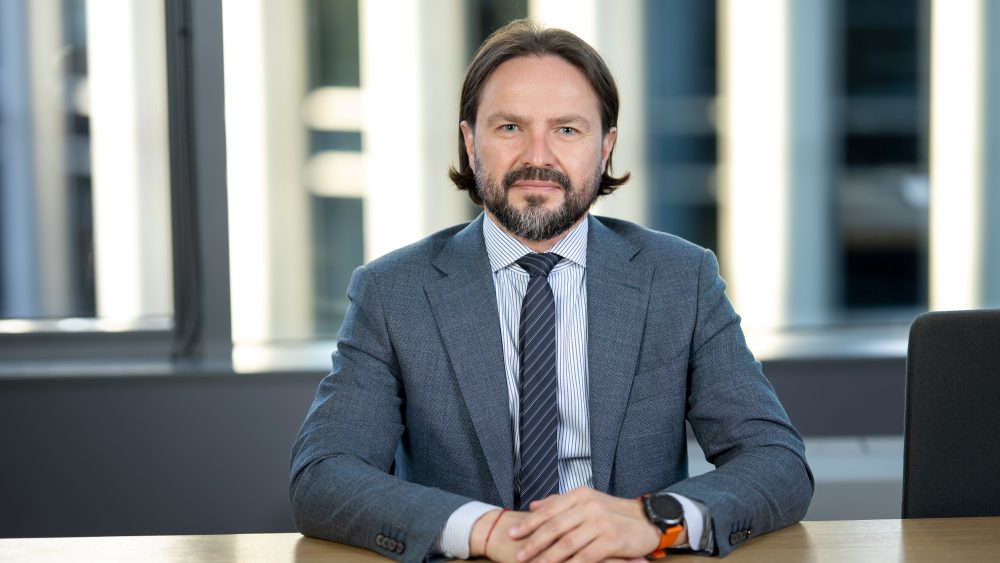
Vilnius’ commercial real estate market is experiencing record vacancy, and the average rate of office space for rent has fallen by almost 55 percent in five years. EIKA Development’s Giedrius Brūzgė reviewed six market trends that are shaping the supply and demand for commercial real estate in the capital this year and changing the concept of a standard tenant.
1. Vacancy at highest level since financial crisis
The Vilnius office segment is divided into A (575 thousand sq m) and B (660 thousand sq m) class offices, the leased area of which has grown on average by 15 and 7.5 percent per year, respectively, since 2018. However, the decline in demand in recent years has led to a constantly growing vacancy rate, which, according to experts, may reach long-standing heights in 2026. Although in percentage terms it will not reach the anti-record set in 2009 (after the financial crisis), the amount of vacant office space is currently significantly higher than then.
“At the beginning of this year, one large class A business center opened its doors in Vilnius, and another one should start operating soon, so it is likely that the vacancy rate of offices in this class will approach 14 percent in the near future. Although this is not yet a Lithuanian record in this regard, the predicted 145 thousand sq. meters of unleased office space will be the highest number in history,” explains Giedrius Brūzgė, Director of the Property Management Department at EIKA Development, explaining the situation in the commercial real estate market.
2. Businesses are growing, but offices are shrinking
According to EIKA Development, the average leased office space in Vilnius has decreased by almost 55 percent over five years – from 930 sq m in 2020 to 425 sq m in 2025. However, these figures do not mean that difficult times have begun for the country’s businesses, but on the contrary – they reveal thoughtful cost management solutions and effective optimization processes.
“We see a trend that large telecommunications companies and banks are reducing the area of their premises, as part of their teams work remotely. Thus, businesses continue to grow, the number of employees does not change, but the need for premises is decreasing. We also notice the so-called hidden vacancy in the market – cases when part of the already rented area is transferred for sublease. Although it is difficult to assess the exact volume of such cases, it is obvious that this contributes to the overall situation in the market. In addition, as the average transaction area decreases, quality becomes a priority – businesses are looking for ergonomically designed premises, paying more attention to the sustainability of buildings and additional services and benefits provided there,” says G. Brūzgė.
3. Flexibility rises on the priority list
The number of new lease transactions in the capital’s office market remains stable in early 2026. However, according to a real estate expert, tenants’ behavior shows greater caution – decisions are being made more slowly, increasingly evaluating not only the price of the premises, but also their long-term benefits for the business.
“This year, the market is recording a continuing trend of recent years: office tenants are actively interested in the flexibility of lease terms, the adaptability of premises, the overall level of building management, and the ability to adapt to changing business needs or policies,” notes a representative of EIKA Development.
4. A more favorable time for change
According to G. Brūzgė, the current situation poses challenges for commercial real estate developers and investors, but for tenants this period becomes an opportunity to assess their needs and improve the quality of the work environment. Businesses are taking advantage of the temporary situation and are more actively planning to move teams to new locations.
“For businesses looking for new space, today’s market situation provides more flexibility and choice. This is a favorable time to expand or renew spaces, adapting them more to the needs of the organization. But this will not last forever. Under such conditions, the development of new projects, at least in class A, has slowed down. It is very likely that vacancies will decrease in the second half of this year and this will continue next year,” the real estate expert emphasizes.
5. The tenant’s image is changing
Recent statistics also reveal changes in the structure of tenants – in both offices and shopping centers, an increasing share of the leased area is occupied by businesses from the service sector, which is gradually changing the concept of a typical tenant. In some new commercial projects, businesses providing services already account for up to 60 percent of the area.
“At the beginning of 2026, the most active tenants of office and shopping center premises remain medical and treatment institutions, sports clubs and educational institutions. It is estimated that such “non-standard” tenants today account for up to 15 percent of the area of new offices in Vilnius. The adaptability of buildings to various businesses is becoming an important competitive advantage in the market,” says G. Brūzgė.
6. The public sector is spreading its wings
As office buildings gradually become not only work spaces, but also social and service spaces, another growing trend is being recorded in the market – the transition of public sector companies to business centers managed by private businesses. There are more and more such examples in Vilnius every year.
“It is no longer surprising to see a clinic, private school or kindergarten located in an office building, but I want to be happy that we are increasingly meeting public sector companies among the tenants. The public sector is moving to more modern workspaces that better meet both their operational needs and employees’ growing expectations for the work environment. In Vilnius, we have excellent examples – the Lithuanian Army, the Financial Crimes Investigation Service, the Ministry of Economy and Innovation or Vilnius Municipality companies. I believe that this is just the beginning and this trend will soon become the norm,” adds the representative of EIKA Development.