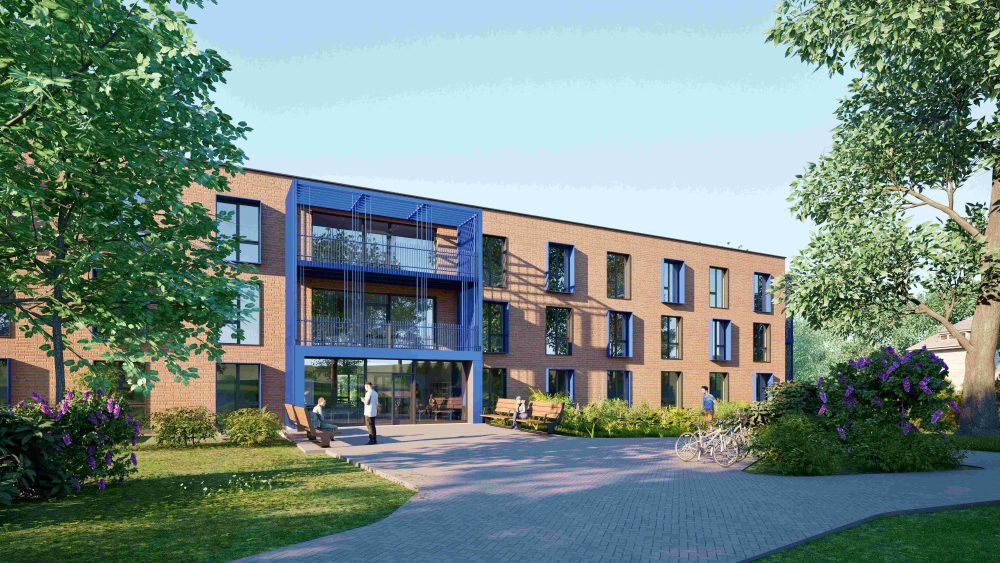
The coliving project in Riga, which was launched by the investment management company EIKA Asset Management (EAM) a year ago, is taking shape. For 3.01 million euros, buildings that previously housed a university were purchased here. EAM plans to invest a total of about 20 million euros in the project and install over 310 high-quality apartments and common spaces that would meet the needs of modern life.
Before starting actual construction on the project, it is necessary to carry out a lot of preparatory work. Last year, design, construction manager and designer competitions and selections took place, and design work began in January this year. Currently, room visions and ideas have been refined by creating an abstract interior design (mood board), which helps the designer and the project client communicate more rationally. Solution drawings have been submitted to the Riga Municipality to obtain design conditions, and design work is also continuing.
“We plan to start actual construction work on the dormitory and administrative building in September of this year, and by then we hope to receive building permits for the reconstruction,” says EAM CEO Andrius Uždavinys. “The project is divided into two stages: during the first, we aim to equip and put the property into operation in the fall of 2026, and the second, depending on various circumstances beyond our control when approving solutions, we plan to complete in 2027.”
Invests in a project where there is little competition
The buildings acquired by EAM are located in the Agenskalns district of the Latvian capital, on the left bank of the Daugava River opposite the Old Town of Riga. This district boasts not only the proximity of the Daugava River and the Old Town, but also green spaces, the reconstructed Victory (Latvian: Uzvaras) Park with the Sakura Garden. By the way, this park is just 100 meters from the Coliving project.
EAM is transforming a complex of four buildings in Riga, covering an area of more than 9,000 sq m, into coliving spaces, which will house over 310 high-quality apartments. The complex will also provide future tenants with a gym, relaxation areas, quiet rooms for work, a cinema hall, an event area and other common living spaces that are typical of modern coliving projects. The project also plans to install a parking lot with places for charging electric cars, and in the inner courtyard and other areas – recreation areas, gazebos, barbecue areas and other outdoor areas.
“When developing this project, we are taking into account the former functions of the buildings – after all, quite recently lectures were held here for university students, and the acquired main historical building of the university is important for scientific and cultural communities,” says the EAM General Director. “We are striving to revive this complex so that active and knowledge-hungry youth can gather there again, and a diverse cultural and social life can take place. By the way, the coliving market in Riga is currently small, and the number of students is quite large for the city.”
In Latvia, over 75 thousand students study in higher education institutions, of which about 10 thousand are foreigners. The majority of them study at universities and other higher education institutions operating in Riga. In the Agenskalns district itself, near the developing Coliving project, there are also several higher education institutions or their faculties.
Already successful in Vilnius
A. Uždavinys emphasizes that the company has already accumulated positive experience in developing coliving. In the fall of 2023, the Solo Society City House Vilnius co-living project developed and managed by the EIKA group, which began operating on Šv. Stepono g. in the capital, has gained great popularity. Last year, before September, it was 100 percent occupied – all 269 rooms equipped here were occupied. The average age of those staying was about 27 years old, 80 percent of them were foreigners. 51 percent of long-term rental residents were students, almost 40 percent were working people. You can stay here for a short (3–29 days) or long (1–12 months) period.
In recent years, the development of co-living spaces has been rapidly gaining popularity around the world. A 2023 residential market study by Savills, a real estate company operating in more than 70 countries, showed that the European co-living sector will attract 2.6 billion euros in investment over the next three years. As many as 51 percent of European investors plan to be active in the co-living sector. In the old continent, this is the third most invested residential asset class, on par with senior housing.
According to Savills, the leading trend in the Old Continent is for Built to Rent (B2R) housing, which is usually larger in size and differs from coliving in the purpose of the common spaces, as well as for Purpose-Built Student Accommodation (PSU), which is similar to coliving housing but is separated into a separate category in the Savills study.