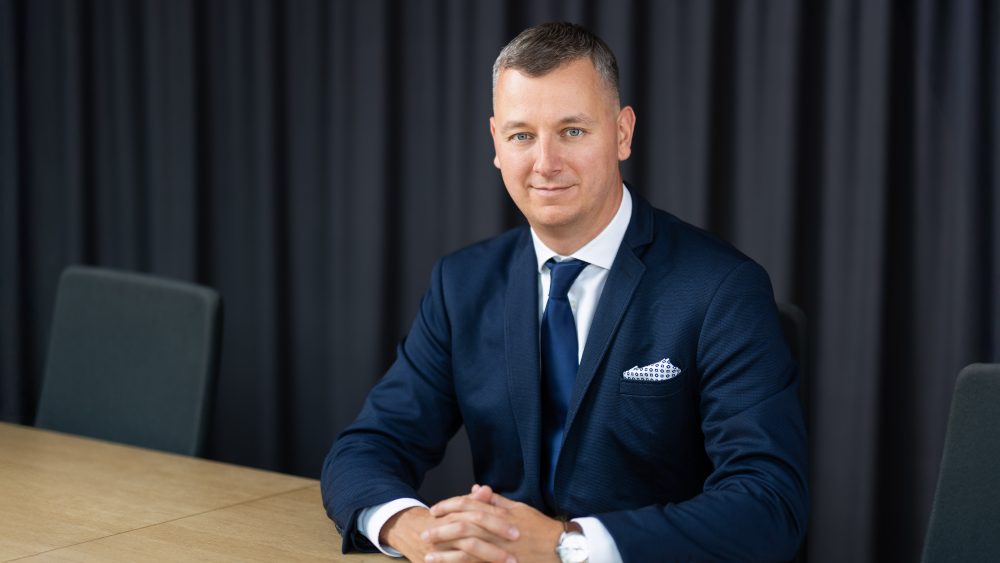
Since February of this year, Andrius Uždavinys has become the CEO of the investment management company EIKA Asset Management. The company, which has been operating for ten years, currently manages 7 funds with an asset value of more than 180 million euros. The company plans to grow more than twice in the next few years.
What was your path to becoming a manager?
I have been working and gaining experience in the field of real estate (RE) for over 18 years. I started my career as a RE market analyst in an international RE consulting company, followed by a longer career stage in several commercial banks, where I spent most of my time helping to manage troubled RE portfolios after the 2008 financial crisis. Then I also had to work in a state-owned company optimizing the managed RE portfolio, until I joined the EIKA group in 2016.
My journey at EIKA Asset Management (EAM) essentially began from the very beginning of the company’s operations. I came to the EIKA group to contribute to the development of investment management activities. Until then, EIKA had been successfully doing this through separate projects and partnerships. I am the first and longest-serving employee at EAM, so I had to try out all areas of the company’s activities. At the beginning of the company’s operations, a team of three people created an organization whose assets under management today amount to 180 million euros. I had to contribute to the establishment of all EAM funds, the creation and improvement of the company’s operational processes. I can confidently say that I know all areas of the company’s activities and know exactly how everything works. Most likely, this is why the new position of EAM’s CEO did not cause much fear, because it seems to organically encompass everything I have done so far.
What experience do you have in managing funds?
My experience in managing funds was very diverse. Before EAM, I had to work in several commercial banks in the country, so regulated activities were not new. However, the management company and fund management activities initially posed certain challenges. One thing is to do business in a project company, where you can change the direction or pace of activities quickly in response to the situation, and another is the field of investment funds, where many things have to be planned in advance, described in fund documents in accordance with regulatory requirements, but at the same time leaving freedom for business and flexibility when the situation requires it.
It is also worth mentioning the great responsibility that the team always feels, because the circle of our clients – investors – is huge, and the credit of trust that we receive with their capital is what motivates us to work even harder. I believe that EAM has managed to balance business and regulatory aspects, and the results of the funds we manage and the positive feedback from investors only confirm this.
In February, EAM received an Alternative Collective Investment Undertakings Management Company (AKISVĮ) license to operate in the European Union. Why is this license important for the company and its clients?
I really liked the congratulatory text I received from one of our partners on this occasion: “Congratulations to EAM on entering the top league of fund managers with the AKISVĮ license.” We feel very similarly.
This operating license, valid in all EU and European Economic Area countries, indicates and confirms the manager’s professionalism and the highest level of operating standards. We have invested a lot of time and effort in the licensing process, improving operational processes and internal procedures. This will allow us to continue to provide the highest quality investment management services in Lithuania and beyond. Considering our expansion plans abroad, this license was necessary to achieve the company’s strategic goals.
Another fundamental change after receiving the AKISVĮ license is that all fund assets must be transferred for safekeeping to a depository, whose main function is to represent the interests of investors and ensure that the fund manager acts honestly and complies with the fund rules and all regulatory requirements. In other words, this is additional security for investors that their capital will be invested in the way and only in the way specified in the fund documents, and eliminates any possibility of non-transparent activities of the fund manager.
It is also worth mentioning that, according to the Bank of Lithuania, at the end of 2024, 39 management companies had the right to manage collective investment undertakings intended for informed investors in Lithuania, while only 9 had an AKISVĮ license. I believe that this fact should make it easier for investors to choose who to entrust their capital to. Especially in cases where the investment products offered by management companies are similar in their strategy, return and risk.
“Invest” magazine, March 2025.