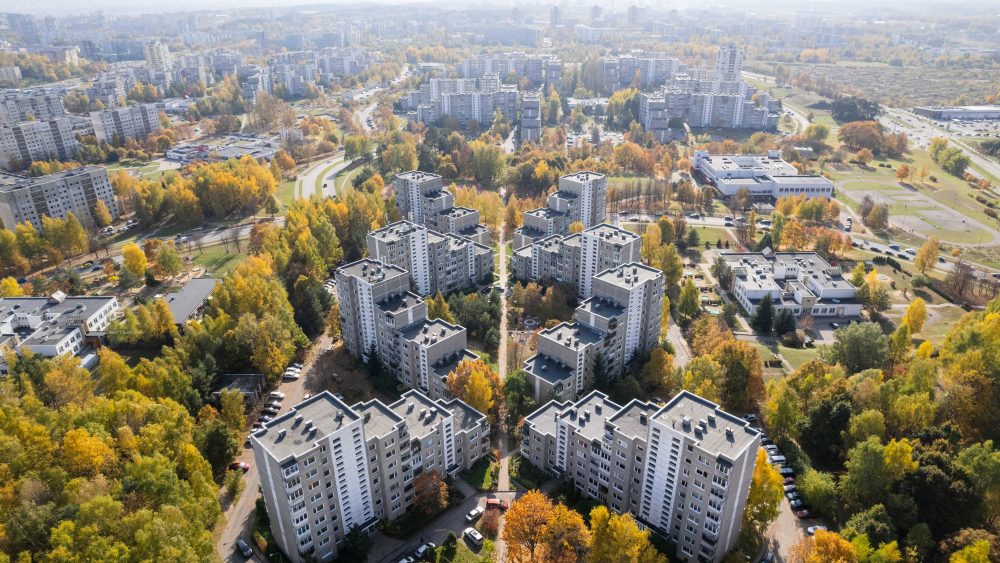
The once prestigious Pašilaičiai neighborhood of Vilnius has been forgotten for a long time, but the abundance of new projects and the huge interest of buyers testify to the rebirth of the district. Real estate experts revealed that a large part of new apartments in Pašilaičiai are purchased by existing local residents, thus demonstrating a good quality of life and a vision for the future.
From 200 peoplem. village to city-sized neighborhood
In 1953, Pašilaičiai was a small village near Vilnius with about 200 people, and today it is one of the largest districts of the capital by population. Now about 45 thousand people live here, and only Verkiai has more inhabitants in the city. For comparison, if Pašilaičiai were a separate city, it would be the seventh largest in Lithuania by population.
The rapid growth of Pašilaičiai began during the Soviet era, when a microdistrict of the same name was built here in 1987, designed by architect Kazimieras Balėnas, who had also worked on the plan of two microdistricts in Klaipėda and designed the Šeškinė, Fabijoniškės, and Karoliniškės districts in Vilnius.
The heart of the microdistrict, which, due to the subsequent development of the district, is now often called the “real Pašilaičiai”, is formed by several main streets: Žemynos, Medeinas, Gabijos, which form three rings around apartment buildings with quiet, pedestrian spaces in the middle. The district, located on a hilly terrain with a lot of greenery, was once considered a prestigious city.
Pašilaičiai stood out from previous dormitory districts in terms of its architecture: for the first time, large-scale houses descending from the center of the street rings outwards were built here, a microdistrict of mass-built block houses appeared on Pašilaičių Street for the first time, the first “Western” shopping center “Pas Juozapą” and the extremely modern PC “Pašilaičiai” for their time were opened.
As the population of the district grew, the social infrastructure was well developed: educational institutions were built, parks and squares were established. Today, Pašilaičiai has 4 schools and 5 kindergartens, a post office, a polyclinic and a medical center, many shops and service points, various sports fields were established, and the first NBA basketball school in Eastern Europe operates.
In the last decade, Pašilaičiai has been expanding mainly in the direction of Ukmergė, the microdistrict has excellent connections with other districts of Vilnius and other cities. There are 12 public transport routes in the district, and by car you can conveniently access the highway towards Panevėžys or the Western Bypass leading towards Vilnius Airport or the highway towards Kaunas.
Moving from Pašilaičiai to Pašilaičiai
Currently, Pašilaičiai is experiencing a revival: new apartment buildings are being built, the number of educational institutions is increasing, new children’s playgrounds and sports fields are being installed, streets, squares and other public spaces are being maintained. Last year, the shopping center “Pašilaičiai PC” was renovated, and one of the largest entertainment arenas in Europe opened its doors there.
For the past 15 years, the population of Pašilaičiai has been growing by approximately 850 people annually, but, according to a representative of the real estate development company EIKA Development, this neighborhood stands out in that a large proportion of buyers of new housing are existing residents of Pašilaičiai.
“In Pašilaičiai, the buyer segments are very balanced – the area is chosen by single individuals, young couples or families with children, couples with children, and investors. However, we notice that a large part of the new apartments are bought right here by people living in old houses who want to renew and improve their living conditions, but continue to live in their beloved area,” says Tomas Žiaugra, development director of EIKA Development.
Last year, a total of 3,662 apartments were sold in Vilnius, of which approximately 7 percent were in Pašilaičiai. Looking at the number of real estate projects currently being developed, it is obvious that the supply in this microdistrict will grow in the near future. For example, EIKA Development is developing a project with 5 housing units in Pašilaičiai, the completion of which is expected in 2027.
“Current trends show that Pašilaičiai will not only remain in the top three most popular bedroom districts in the district, but will also potentially become a leader in Vilnius. The comprehensively developed infrastructure, shopping centers, schools, kindergartens and leisure spaces in the district meet the various needs of residents,” adds T. Žiaugra.
In the near future, some public spaces in Pašilaičiai will be renovated, such as Chicago Avenue or Ugnijos Square, where community celebrations are held every year. A new square is also planned on Medeinos Street, a new junior high school is being built, one of the kindergartens is being expanded, and a newly completed Catholic school and kindergarten will open its doors in the fall.