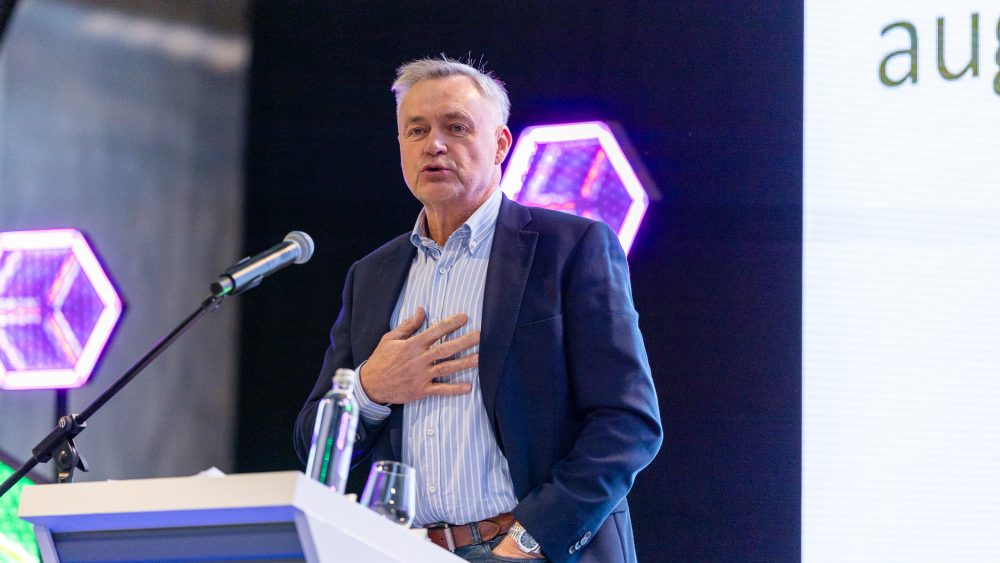
City leaders must know what kind of city they want to create, have their own vision, mobilize experts and the community – it is the municipality that must be the key city developer, knowing the direction and the overall plan, is convinced by Robertas Dargis, Chairman of the Board of the EIKA Group, Member of the Board of the Lithuanian Real Estate Development Association (LNTPA), Vice-President of the Lithuanian Confederation of Industrialists. He spoke about the problems he sees and the solutions he proposes today, November 13, at the 18th Lithuanian Urban Forum, which was held on November 13, where all attention was paid to a functionally balanced, sustainable and economically logical city.
The municipality is the main developer of the city
Dargis recalled that back in 2006, this urban planning forum was born to bring together everyone working in this field and have a place where it would be possible to discuss problems, challenges, and opportunities common to everyone who creates and grows cities.
“The growth of free Lithuania lacked certain generalizations, insights into trends, and at the same time joint work with legislators, city administrations, architects, real estate developers, or investors,” he noted.
Dargis regretted that after the restoration of independence and the subsequent reforms, one of the most important areas of the state economy – urban planning – was undeservedly underestimated. Having become Chancellor of the Government in 2000, he proposed placing the management of land policy in the hands of the Ministry of the Environment, so that planning and land management policies would be viewed not as separate, but as common areas.
“With Prime Minister Andrius Kubilius, we had prepared the transfer of the National Land Service to the Ministry of the Environment, as well as land management to municipalities, but President Dalia Grybauskaitė was opposed to this. But, as you know, as of this year, the city finally has its own land,” he said happily.
Dargis is convinced that the main developer of the city is the municipality itself: “It is it. Not “Citus”, not “Hanner”, not “Eika”, but the city itself and its leaders. The city, the mayor of the city, who has in his hands a vision of what he wants to see the city in 15-20-25 years, is the main developer of the city.”
The recipe for success lies in communities
In Dargis’ opinion, a city, with planning capabilities in its own hands and managing its own land, can implement sustainable urban growth: “A city, seeing all layers – economy, infrastructure, education, health, sports, social issues – can and must set the tone for all communities operating in the city.”
According to him, the 21st century is significantly changing the understanding of the modern city.
“Environmental protection, greenhouse gas emissions, technological and social changes are also shaping a different understanding of what a city can and should be like. Technological changes are increasingly leading to the disappearance of pure territories – residential, commercial, and office – and increasingly developing territories that we could call multifunctional. But this requires the joint contribution of everyone who works, lives, and studies here. A city is, first and foremost, the people who live here and their communities,” said R. Dargis.
He noted that the main key to the success of a growing city is the ability of city leaders to involve city communities in creating its future: “The ability to bring together city communities, investors, and the vast scientific potential to create and implement a vision for the city of the future creates huge opportunities not only for the city itself, but also for the region.”
Vilnius can become a regional leader
Dargis is convinced that today Vilnius has all the prerequisites to become a regional center not only among the Baltic countries, but also compared to the northeastern region of Poland.
According to him, there are all the necessary prerequisites for growth: the economy is growing the fastest in the region, technological development is sometimes growing in just a few years, salaries are growing along with people’s purchasing power, we have a strong academic cluster covering areas from traditional sciences and arts to modern biotechnologies, a medical cluster uniting a university, hospitals, and research centers.
When thinking about what should be done about this, R. Dargis once again reminded us of the need for a long-term vision: “The growth and development of the city must have clear plans, ambition, in which directions, to what extent it will grow and how we imagine what Vilnius will look like and how many residents it will have, for example, in 2040, where they will live, work, have fun, study, get medical treatment, etc.”
Identified issues to be addressed
Dargis said that the main improvement of the city’s quality is in no way determined by the emergence of one or another developer’s project: “We must constantly monitor and plan the development of the infrastructure of residents, and one of the main things related to this is movement in the city. People not only live in the city of Vilnius – about 10 thousand people also visit here every day, and the movement schemes of all of them are a prerequisite for effective city life. The correct city transport infrastructure allows people to save time that they spend in traffic jams.”
It is also necessary to address the issues of the quality of the urban environment. “We can achieve a lot here by working hand in hand with developers. Accumulated, planned green areas, the implementation of which can be achieved by pooling funds, would be an alternative to the tireless fight for the survival of one or another tree. It is necessary to understand that trees, like people, grow, grow old and die, and if one tree inevitably hinders the planned development of the city and can be replanted, the question must be raised as to what position should be correct,” he noted.
One of the key aspects of sustainable urban development is the economy. “The cost of living is consistently rising and perhaps this should also partly help decide what kind of city should be developed. More efficient use of engineering infrastructure, priority for the use of urban transport should determine the scale and trends of the city,” said R. Dargis, noting that a city is not simply a collection of single-family homes.
Also, according to him, we should think about housing affordability, social housing, take into account the territories surrounding Vilnius and the people living there, and their convenient connection with the capital.
No investment analysis
Although the city of Vilnius is the locomotive of the Lithuanian economy, R. Dargis regretted that an analysis of its economy and investments has not been conducted to date, it is unclear how much has been invested in the city over the last 10 years, what the investment plan is for the next 15-20 years, and what sectors we want to attract investments to.
It is also necessary to decide what kind of tax system would enable planning of city governance. “We often talk about real estate taxes without understanding – I am convinced that taxes should be the instrument that ensures the vitality and development of the city. This is a fee for a service that, as we sometimes mistakenly think, costs nothing.”
In addition, the city can use its capabilities to consolidate territories so that they are developed and absorbed sustainably, and it must also have continuously operating urban development workshops.
“We need to have a certain workshop where both developers, architects, and academics could interactively participate in solving urban problems. The social aspects of urban growth should be mentioned separately – the involvement of professional sociologists and socioeconomists in urban development would allow us to see the future of the city through the eyes of different generations of urban residents,” said R. Dargis.
According to him, one of the possible instruments for implementing ambitions could be private-public sector partnership projects: “Let’s not forget that the rain of European money will change beyond recognition after 2028.”
Attention should also be paid to city highlights, art spaces, sculptures, or other works that create a vibrant cityscape.
Action is necessary.
Dargis also identified the actions that should be taken to implement the necessary changes.
“Together with the city administration, the Chamber of Architects, cultural heritage institutions, city communities, and the academic community, we need to establish a permanent urban development forum where we could discuss our visions and problems related to the future of the city. City council members and the parties that delegated them need to be included in the active plan and implementation of creating the city’s future – their involvement would allow us to be much closer to realizing the ambition,” he suggested.
The next necessary step is to discuss with the city administration, planners, and urban planners what the planning and coordination process should be like, what should be regulated along with laws, government resolutions, and other by-laws.
“I think we need to have an effective ombudsman institute – a kind of arbitration that would resolve emerging problems. We should also review and amend the city’s general plan at least once every two years, making the necessary corrections that occur over time,” suggested R. Dargis.
“The kind of Vilnius we, our children and grandchildren will see will depend on the activity and involvement of all of us,” he reminded.