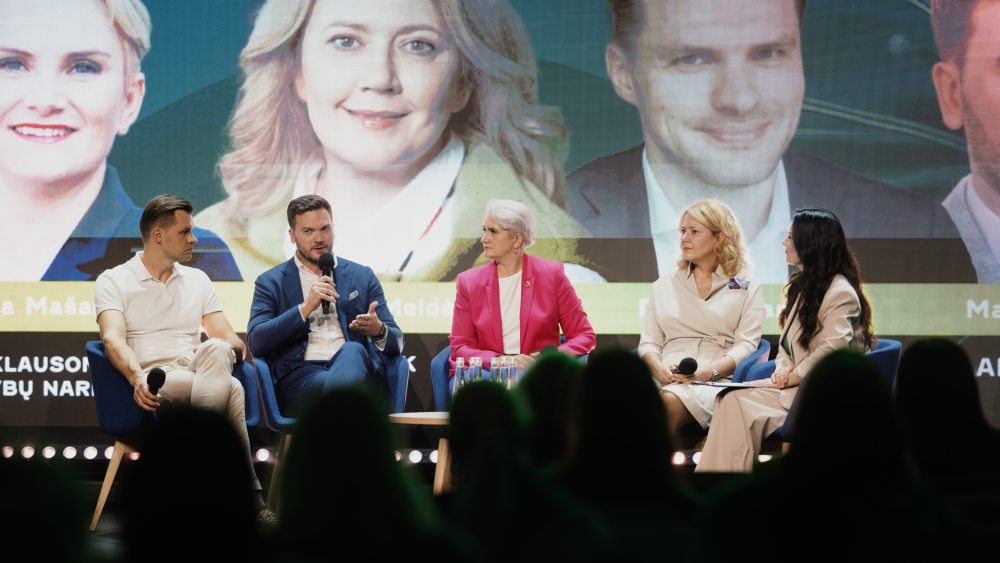
Domas Dargis, CEO of the EIKA group of companies, does not hide the fact that private housing customers are not yet pressuring them regarding sustainability requirements, and they are even more reluctant to pay more for it from their own wallets. However, he maintains his belief that in the long term there is simply no other way for business and it is better to be prepared now. Last week, at the discussion of the Sustainability Plan conference, he and other business representatives talked about what a sustainable business really is and what to do so that a commitment to sustainability is not just a loud declaration.
Even for a beautiful idea, not all means are suitable
It seems like everyone is talking about sustainability now, and regulations to ensure it are increasing. However, Orijana Mašalė, an independent board member, urged people not to lose their heads in the discussion.
“I believe in the idea of sustainability itself, but I don’t believe in all the measures that are decided to be implemented in the name of this idea,” she said.
As an example, she gave the European Union’s requirement for aviation, a seemingly nice idea, that by 2030, aviation would use 5 percent of so-called sustainable aviation fuels, which are made from things like oil, fuel, various bio-wood waste, etc., instead of classic aviation fuel.
O. Mašalė also revealed that although some airlines offer to pay a rather symbolic fee, 2-3 euros per piece of aviation fuel, only 0.5 percent of travelers agree to do so. “It’s brutal, but these are the statistics,” she said.
Customers don’t want to pay
The head of the EIKA group, D. Dargis, also revealed that perhaps 1 percent of their customers would be willing to pay more for sustainability: “We would in no way base our business model on the fact that our customers would pay more for sustainability. No one would pay more for sustainability – not a single euro.”
He shared an experiment he conducted at the company that perfectly revealed public attitudes.
“In one project, we offered to give every apartment buyer a piece of a solar park so they could generate their own electricity. And guess how the customers reacted? In the end, none of them agreed to invest in a solar park, the only question was how much it was worth, a few thousand, they asked, “Can you lower the price of the apartment for me by that amount?”,” he said.
However, banks look very favorably on sustainable companies and projects.
“Finance professionals would talk more about the influence of the banking sector, but the fact is that they are pressured, forced to favor sustainable companies and sustainable projects, so that we can get exceptional, unprecedented conditions for financing our projects – I can confirm that. We have a new business center, one of the most sustainable buildings in Vilnius, “Flow” – I was very pleasantly surprised that it was probably one of the most favorably financed projects,” said D. Dargis.
Kristina Meidė, the head of LTG Link, noted that although her sector of activity inherently aims to shift people from cars to trains, that is, to travel in a more sustainable way, few travelers’ choices are determined by sustainability.
“We are thinking about what to offer them more – greater convenience, faster communication, service, time for ourselves. And we must always think about how to make it so that the customer does not have to pay more for a sustainable choice,” she said. Akola Group Board Member and CFO Mažvydas Šileika emphasized that when talking about, for example, the food sector, sustainability cannot be understood narrowly.
“The biggest changes come where there is customer demand. Food must first and foremost be tasty and affordable for a person – it is a necessary commodity for him, he is willing to pay as much as he can for it. There are very few people who agree to pay a premium for sustainably produced food, but you can’t mix that with ecology. What the war in Ukraine has shown in real life is that another important topic is food security. We import a lot of raw materials that we use to produce food – the European Union must sustainably secure its food supply,” he gave an example.
The first task is to convince managers
What does it take to make sustainability a reality for a company? The discussion participants were unanimous – first and foremost, the leader must set the tone.
“I don’t believe in any transformation in a company if the top manager doesn’t believe in it – it all starts with his belief and involvement,” said K. Meidė.
Šileika reiterated that although internal calibration starts with the manager and the board, there must be a member specifically responsible for the area of sustainability: “Sustainability truly becomes sustainability when it is embedded in the company’s top-down strategy, when resources are allocated to it. Then decisions are made more easily when there is that cultural part, if you start from the top, implement, allocate resources, cascade culture into people’s thinking – that barrier is one of the most important.”
D. Dargis admitted that he didn’t even need to think about it much himself – after becoming the CEO of EIKA, he already had his own vision that not only profit drives businesses, and it just so happened that sustainability was a topic that matched his worldview.
“What’s difficult for me today is that not everyone believes in sustainability and thinks they can somehow avoid it. I’m talking about company managers – we have maybe ten companies in our group. It hurts me personally, why do I have people working in my team who don’t believe in what we’re doing at all? But I took it as a challenge, I’m curious whether people’s worldview can change, or whether people will have to be changed,” said D. Dargis.
He said that although the EIKA group of companies will need to submit a sustainability report for 2025, they decided to do it now and be prepared for all regulations in advance.
“My challenge is to simplify sustainability so that it is very simple, obvious and easy for people on the team. I want that revolution in sustainability, the realization that if you act wisely, it is inexpensive, simple, even economically worthwhile,” said the head of the EIKA group.
“Yes, we are making sure that sustainability goals do not harm the business model, we are looking for investments to be profitable or at least the difference to be insignificant, maybe 3-5 percent, not a few times, but we are on that path,” D. Dargis assured.