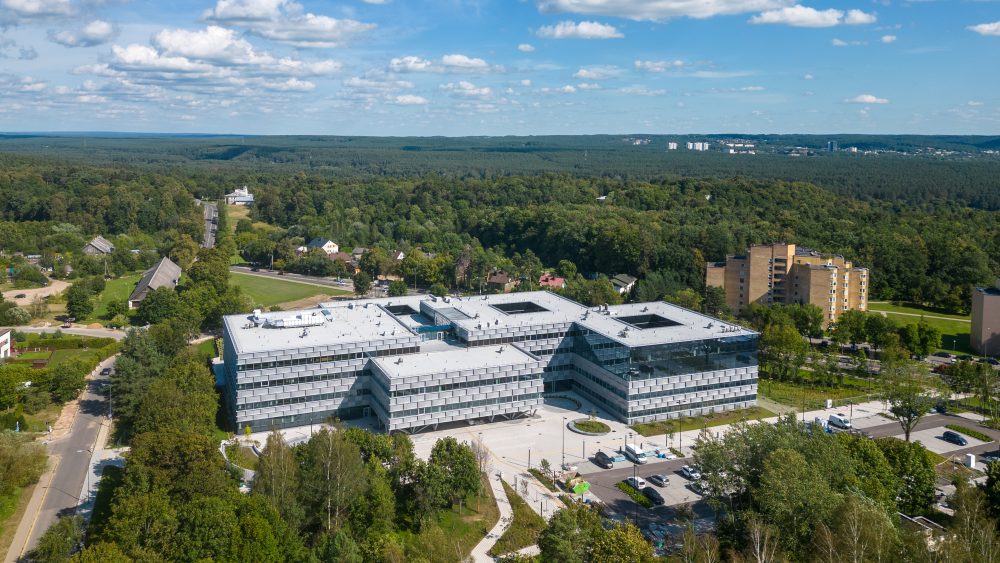
The Medical Science Center of the Faculty of Medicine of Vilnius University (VU) has been completed in the Santara Valley in Vilnius. It will host not only lectures for students of the Faculty of Medicine, but also various scientific research. The project was implemented by the construction company EIKA Construction (formerly – “EIKO Construction”). Currently, construction work has been completed and the procedures for handing over the building to the state commission are underway.
A new space for top-level research and studies
The modern Medical Science Center consists of 6 buildings with almost 900 rooms, the total area of which is 19 thousand square meters. The value of the project (excluding furniture and equipment installed by the customer) is almost 50 million euros. Almantas Čebanauskas, head of EIKA Construction, does not hide the fact that this project had difficult challenges, which were determined by complex circumstances beyond their control.
“The tender was announced in 2019, and the contract was signed in 2021. During that time, both the technologies themselves, engineering solutions, and the customer’s needs have changed a lot – this led to a number of changes to the project. Then the COVID-19 pandemic came, and later the war began. All of this had a significant impact on the cost of construction work and the implementation of the contract in general. However, with the builder and contractor working closely together, we managed to find solutions and successfully complete the project,” says A. Čebanauskas.
This center is a new and modern place for the study process and the high-quality implementation and development of top-level medical research: “The pandemic period has once again demonstrated the importance of medical science and the meaning of investments in this area. The new VU Medical Science Center will create conditions for further development of health sciences at the highest international level and will provide new opportunities for interdisciplinary cooperation, which is necessary for further progress on the path of advanced, individualized, science-based medicine,” says VU Rector Prof. Rimvydas Petrauskas.
The new Medical Science Center will house the Translational Health Research Institute (TSTI) of the Faculty of Medicine of Vilnius University, established in 2024, whose activities are planned to be focused exclusively on research in the field of medicine and health sciences. The research groups operating at the institute will unite the best scientists in fundamental and clinical fields, creating innovations and conducting research that overcomes medical challenges. The newly established institute will house research groups working with digital medical technologies, analyzing disease mechanisms and treatment options at the organ, cell and gene levels, and laboratory animal departments where experimental surgery, neurosurgery and oncology research will be conducted.
The first paleogenetics laboratory in Lithuania
In addition to exceptional dentistry, neuroscience, 3D structure evaluation and printing, and other specialized scientific laboratories, the first paleogenetics laboratory in Lithuania will help assess the evolution of health and diseases. The institute will also open the first third-level biosafety laboratory, allowing for scientific research with extremely dangerous infectious agents.
“The center will also open a Lithuanian population and rare disease biobank, where samples and data from the Lithuanian population will be collected for research into the health characteristics of the population. The Simulation Center operating here will open new opportunities for students of medicine, dentistry and other study programs to develop practical skills during their studies. The Medical Science Center of the Faculty of Medicine of Vilnius University, located next to Santara Clinics, will also better meet the needs of the medical community – the established conference halls, auditoriums, meeting and practical training rooms will create conditions and encourage the sharing of scientific ideas and their verification by conducting scientific research in the center’s laboratories,” says Prof. Dalius Jatužis, Dean of the Faculty of Medicine of Vilnius University.
It is expected that the innovative infrastructure of the Medical Science Center will help TSTI scientists create an exceptional medical research base that will bring together scientists from different fields, students, and the public and contribute to medical progress.
Although EIKA Construction has previously constructed buildings for scientific purposes, this Medical Science Center was unique in its size and complexity.
“Since this is a Medical Science Center, appropriate requirements were imposed on some of the premises. In addition to the auditoriums, biorepositories, various laboratories, operating rooms and other similar premises were also installed. Compressed air, deionized water purification, technological gases, gas extinguishing, central dust collection and other systems were installed, of which there are more than 90 in the building in total. Accommodating everything without reducing the usable area was a difficult task and it certainly would not have been possible without spatial modeling of the building,” says A. Čebanauskas.