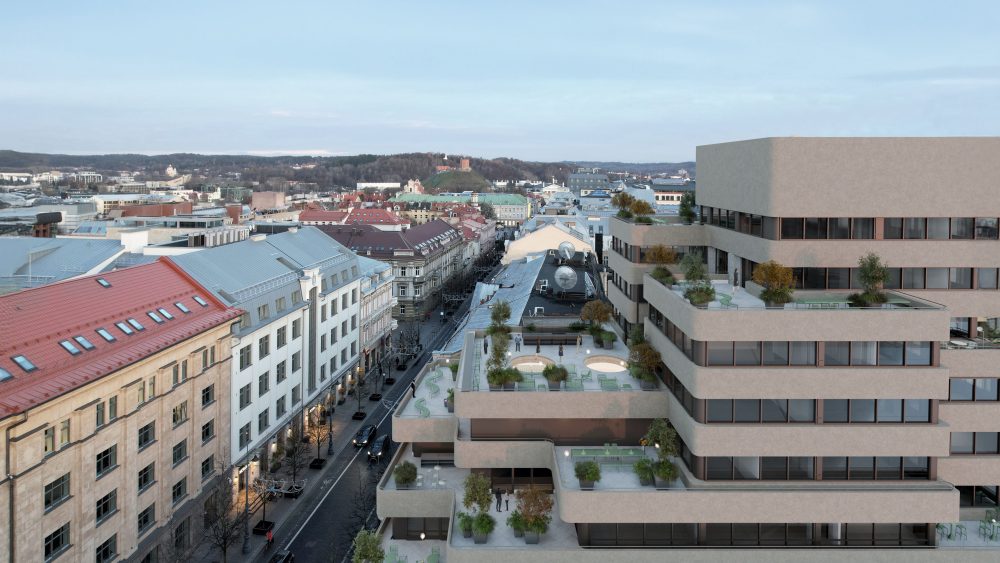
In 2024, the real estate development and project management company EIKA Development organized a competition for the conversion projects of two buildings on Vilnius Gedimino Avenue. It turned out that the best project for the building at Gedimino Ave. 26 was prepared by the architectural company Fragment Architektai, and for Gedimino Ave. 28 by Aketuri Architektai. The client of this competition and the owner of the buildings is the Cooperative Company Lithuanian Cooperatives Union.
The winners were selected by professionals
5 architectural firms submitted projects for the conversion of the building at Gedimino pr. 26, and 4 architectural firms presented their work for the building at Gedimino pr. 28. The best project developer was selected by the members and board members of the Cooperative Company “Lithuanian Cooperative Union” and well-known architects – Rolandas Liola (UAB “Arches”) and heritage objects expert Irena Kliobavičiūtė (UAB “Senojo miesto architektai”). A well-known architect and associate professor of the Department of Architecture of Vilnius Gediminas Technical University Saulius Pamerneckis (UAB “SP architektų grupė”) was invited to review the competition.
“We understand what a huge responsibility it is to change the face of buildings that are familiar to many Vilnius residents, located in the very center of the city. The time has come to update them and adapt them to the needs and standards of this era. Therefore, we are very grateful to everyone who agreed to devote their time, expert knowledge and energy to evaluating the ideas of the competition participants, all of which were truly worthy of attention, but together we managed to select the best ones,” says Marius Šukauskas, General Director of the Lithuanian Cooperatives Union.
“I am very happy to have assembled a team of top-level professionals, who are waiting for a challenge worthy of them. This is our function as professional real estate project managers: to offer the best vision that meets the needs of the real estate owner, prepare an investment plan for the project implementation, and assemble the best possible team to implement that plan. I am looking forward to seeing the diamond of Lithuanian architecture shine with new colors,” says Martynas Žibūda, CEO of EIKA Development.
Gedimino Ave. 28 building – for offices and the building community
The best project for the administrative building at Gedimino Ave. 28, with an area of 6,210 m2, was submitted by “Aketuri architektai” (Ieva Marcinonytė, Kotryna Velutienė, Aušrinė Ragelytė, Milda Rekevičienė, Simonas Kazlauskas, Gvidas Nienius, Andrius Maksimavičius, Julius Šeibokas).
Their team member Julius Šeibokas admitted that for him this building of the Lithuanian Cooperatives Union is the most beautiful in Lithuania – this is partly due to personal reasons.
“I may be a little biased here, but architectural experts, connoisseurs, enthusiasts, and everyone else who has seen this building cannot remain indifferent: experts appreciate it for the application and implementation of construction technologies unique to Lithuania at that time, its adaptation to the sensitive urban space, complementing and enriching it, while others appreciate it for the aesthetics, curves, and uniqueness of the interior of the building,” he said.
“The building of the Lithuanian Cooperative Union was built by my father Justinas Šeibokas in 1978-1986, according to the order of one of the richest unions in Lithuania at that time. From my father’s stories, I have heard many legends about the difficulties that arose during the design process in convincing the nomenclature of the correctness of the idea. The construction of this building was unique for the period of construction: the frame type of prefabricated construction allowed the implementation of the idea of free planning. The exterior of the building is also unique – a plastered facade, which even today and after so many years looks great (except for a few physical damages), at that time only the highest qualified craftsmen could install such a facade system, which could be counted on the fingers of one hand in Lithuania,” said J. Šeibokas.
When starting to prepare a proposal for the renovation of the building, “Aketuri architektai” set themselves the task of not damaging it, of making what was not working work, of highlighting what was valuable, and of emphasizing the spirit of the building.
“The main design idea is to maintain the existing spirit of the building, making minimal additions and renovations, thereby highlighting and honoring the existing architecture and aesthetics of the building and preserving valuable features, activating terraces, creating more natural light sources inside the building. The building is unique in its shape, which is clearly visible during the day, but disappears in the evening. To change this, we plan to install outdoor lighting that highlights the shape of the building in the dark. Currently, the windows on some floors do not maintain the original rhythm, we plan to restore it,” said J. Šeibokas.
According to him, the aim is to make the building alive not only inside, where office spaces are being designed, but also outside – terraces are being allocated, renovated and opened for offices and the building community, and potted greenery and outdoor furniture are planned.
“The proposal created by us with the “Aketuri” team was prepared after clarifying the goals, and it is also a very personal project for me: I am the custodian and supervisor of the authorship of this and other buildings designed by my father, therefore these ambitions accompanied the creative process,” J. Šeibokas did not hide.
Luxury apartments will be located at Gedimino Ave. 26
The authors of the winning project at Gedimino Ave. 26 are “Fragment Architects” (Berta Meironaitė, Povilas Čepaitis, Gabrielius Černiauskas, Ignas Kundreckas). The 11,238 m2 administrative building located here will be reconstructed into luxury apartments for rent and commercial premises on the ground floor, and the courtyard extension will be converted into offices or small apartments/studios for rent.
“In proposing our idea, we sought to create a complex that would be characterized by diversity and harmony. Each of the three buildings that make up the complex has its own expressive and contemporary architecture, and together they illustrate the interesting and rich development of this part of the urban fabric,” said P. Čepaitis.
“The main principle that we followed when developing the concept of this project was to create as much space as possible on a tight plot of land around the main highlight of this place – the administrative building of the Lithuanian Cooperative Union. Not to build it up, but, on the contrary, to frame it and provide an opportunity to look at it, while ensuring daylight access to the administrative premises and forming a spacious and cozy inner courtyard of urban proportions. Such an urban solution is also contextual, as it is characteristic of all adjacent plots,” he explained.
“We propose to make the superstructure above the street body a laconic single-pitch, choosing the angle of the roof such that it would be essentially invisible when viewed from Gediminas Avenue. The architectural expression of the superstructure with many glass and metal elements reflects lightness and softness. We propose to fundamentally rebuild the courtyard facade: to enlarge the windows, unify their rhythm and architecturally adapt them to the new superstructure. The facades of the courtyard body have contextual links with the surrounding buildings: the rounded corners match the architectural forms of the adjacent administrative building, and the selected yellowish clinker finish is characteristic of most of the historical architecture of the Vilnius city center. In those places where the courtyard body is blocked by neighboring buildings, the volume is lowered and a continuous glazing strip is inserted – to make the joints more sensitive and gentle. Despite the fact that the new volume harmoniously blends into the environment, it has an expressive character and completes the centuries-old architectural ensemble.
“The focus on the spaces surrounding the buildings, light, a respectful relationship with the surrounding context, and simplicity were the essential features of our proposed concept. Which, it seems, the evaluation committee also paid attention to,” said P. Čepaitis.