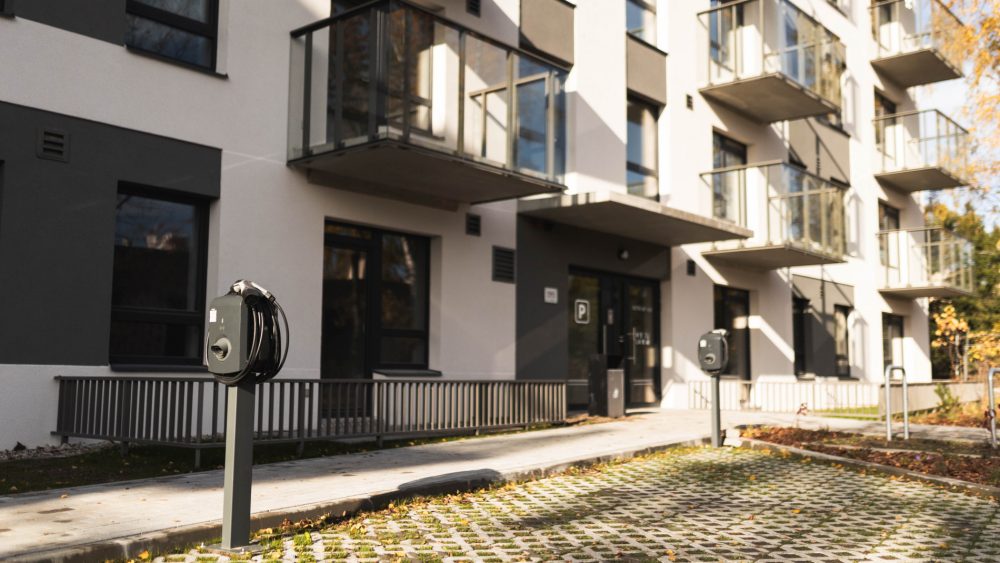
Changes in the transport sector usually affect many more areas of life: for example, increased transportation costs usually mean an increase in the price of everyday goods, while the increasing number of electric cars on the roads has led to the updated technical construction regulations. It provides for the installation of 20 percent of parking spaces with the possibility of charging electric cars when constructing or reconstructing new buildings. The installation of stations alone does not cause major concerns, but builders also face other challenges related to this new requirement.
“With the emergence of this requirement, one of the main puzzles for builders has become the distribution of power in the facilities – what part of it to allocate for charging needs, and what part to leave for other needs. Also, of course, the purchase of additional power from the electricity network operator. This means increased costs for the production or reconstruction of the building,” commented Jolanta Dobradziejienė, development project manager at EIKA, on the changed procedure.
It is true that, statistically, about 70-80 percent of drivers charge their electric cars at home at night, companies that install charging stations and related solutions offer smart solutions that allow you to avoid additional costs when preparing a more powerful input. For example, the company “Ikrautas”, in cooperation with “EIKA”, has already applied the power distribution solution in the newly built apartment project “Metų laikai” in Vilnius.
“Since most charging takes place at night, in other words, at a time when the apartment building itself requires the least electricity, it is possible to balance the electrical system of the building’s common areas so that it is distributed according to demand. This means that during peaks in electricity consumption, for example, after working hours until evening, there is a possibility that electric cars will charge more slowly, and at night, when electricity consumption is low, additional electrical power can be directed to charging cars for the building’s common needs, such as elevators, parking lot lighting and other common areas,” said Paulius Gūžys, head of the company “Ikrautas”, about the proposed solution and noted that the main goal of the system is to use the available power input in the building as efficiently as possible.
Mr. Gūžys says that the power distribution system is programmed to prioritize the needs of residents. This means that if at some point, when connecting electric cars, the permitted power limit for general consumption is approached, the charging power will be temporarily reduced. However, since charging at stations installed near homes usually takes several hours, a 10-15 minute longer charging time will not have a significant impact on the final result.
The aforementioned apartment building project has 28 charging stations from the Dutch manufacturer Alfen – 7 in the above-ground parking lot and 21 underground – which residents will be able to use after purchasing parking spaces with charging stations. To make the stations more convenient to use, they are linked to a mobile app, where you can view charging histories, set charging schedules, or use other smart functions. This is also a convenient accounting solution, as information about each charging is transmitted to the building administrator, and everyone pays for the electricity used to charge their electric car along with the general building administration fees.
J. Dobradziejienė commented that although such solutions are an additional challenge in design and construction, the ability to charge electric cars near homes can significantly contribute to the value of real estate: “Previously, it was common to believe that electric cars were intended for those who live in private homes, but the updated building regulations and the projects we implement in accordance with the new instructions can fundamentally change the habits of residents using electric cars.”
The representative of the company “EIKA” also mentioned that this project is a pilot project, and in the near future it is planned to develop a project that will implement an even more efficient power usage solution. The power distribution planned in the new project will include not only general needs, but also energy usage in apartments.