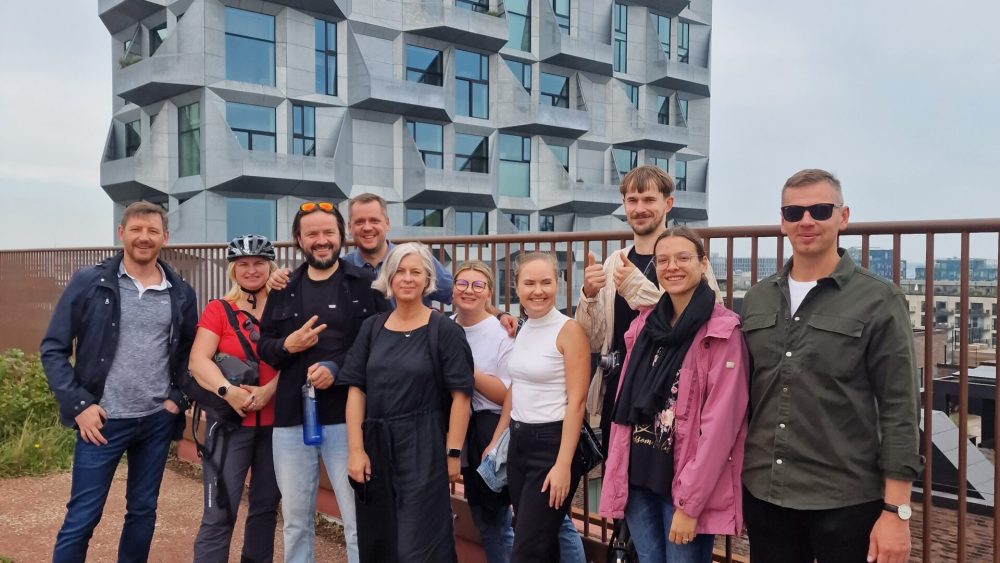
The Eika team ended September by learning from a great example of sustainability in all of Europe – Copenhagen. The team of ten employees delved deeper into how the Danes manage to live so sustainably. We share many moments that we captured or remembered.
The whole of sustainability or why the Danes succeed. The ingredients of success: state regulation, public awareness and the ambitions of market participants.
Denmark not only declares the implementation of sustainability in words, but has very clear regulations on how they strive for sustainability. The real estate sector has set and is gradually pursuing a CO2 footprint indicator for newly constructed buildings, not to mention the functionality of each building – how much of it is allocated for social needs. For example, usually the entire first floor, or the environment being created, must serve the public through services or other activities, and if the area of residential projects exceeds 8 thousand sq. m, 15 percent must be given over to social housing. Another unique thing is that entire districts are developed, where the detailed plan is thought out and discussed primarily with social services for future building users – residents or employees in mind. Therefore, schools, kindergartens, catering establishments, mobility options – bicycle paths and parking lots, metro stops – are being created, and cars are being “put” underground or in multi-storey car parks. The remaining above-ground areas are minimal, and most importantly, only sleeping areas are not being developed. Excellent examples of district conversions: Nordhavnen or the Carlsberg factory site. We believe that this was achieved through dialogue between all stakeholders, and not just unilateral demands.
A city for a person. The once inaccessible areas of the port have become the “Blue Park” with purified water suitable for swimming or a public free natural pool fenced in the water area, which the townspeople enjoyed even at the end of September.
Thinking about the future. One central street has been reconstructed so that a large green area has appeared in the middle of it, which actually serves to absorb heavy rain and manage possible flooding. A huge investment that has not only created a new green area, changing the face of the city, but also a look ahead, as rainstorms become more frequent.
It starts with yourself. We visited three design and architectural offices. Two of them are located in converted premises – a shopping mall and a port warehouse, and the third is in a locomotive repair shop, which they accepted as it was, did not even repaint the walls, and brought the stairs to the second floor from another part of the building. “So what, we plan to be here for a few years, then we will look for other creative spaces when it is decided to convert this building”. The sustainability philosophy of the employees of this office really encourages us to think about how we have become accustomed to comfort, without thinking about how much our comfort costs the planet. When asked how they survive the cold (the office really seems permeable), in their opinion the cold is not terrible, after all, they can dress more, it is harder to bear the heat (there is no air conditioning), but in July the whole office goes on vacation, and other heat waves they survive by jumping on a bike and diving into the sea a couple of minutes away. Just don’t think that the desks are wrong or the multimedia is from the last century – not everything is really comfortable here. Everything else is a matter of attitude. Danish architects set themselves the goal of building less new, using as few materials as possible or using recycled ones, and any newly constructed building must be constructed in such a way that it can be easily converted to other functions if a new need arises.
Most likely rental housing. Here we will just ask the question, would you rush to rent, or maybe buy, a house whose facade is formed from the walls of another old building’s facade, and the floors are made of the remaining ends of floorboards left for disposal? And in Copenhagen, in one such investment project for rent, the vacant apartments are rented out the fastest, if we compare the context of the district, and certainly not at the lowest price. By the way, air conditioners are also illegal in Denmark. Danish society values what is sustainable, does not use resources that can be left unused.
The Eika team didn’t get off their bikes for the entire three days, we didn’t get in the car, and we took the metro to and from the airport and one office.
Thanks for the inspiration and thoughts for the future: https://lendager.com/; https://www.cobe.dk/; https://abc.dk/
[vc_gallery type=”image_grid” images=”46771,46769,46767,46765,46763,46761,46759,46757,46741,46743,46745,46747,46749,46751,46753,46755,46739,46737,46735,46733,46731,46727,46729,46725,46709,46711,46713,46715,46717,46719,46721,46723,46707,46705,46685,46683,46681,46679,46677,46661,46663,46665,46667,46669,46671,46673,46675,46659,46657,46653,46655,46651,46649,46647,46645,46643,46641,46639,46635,46637,46633,46631,46629,46627,46625,46623″ img_size=”medium” el_class=”zoom-in-gallery”]