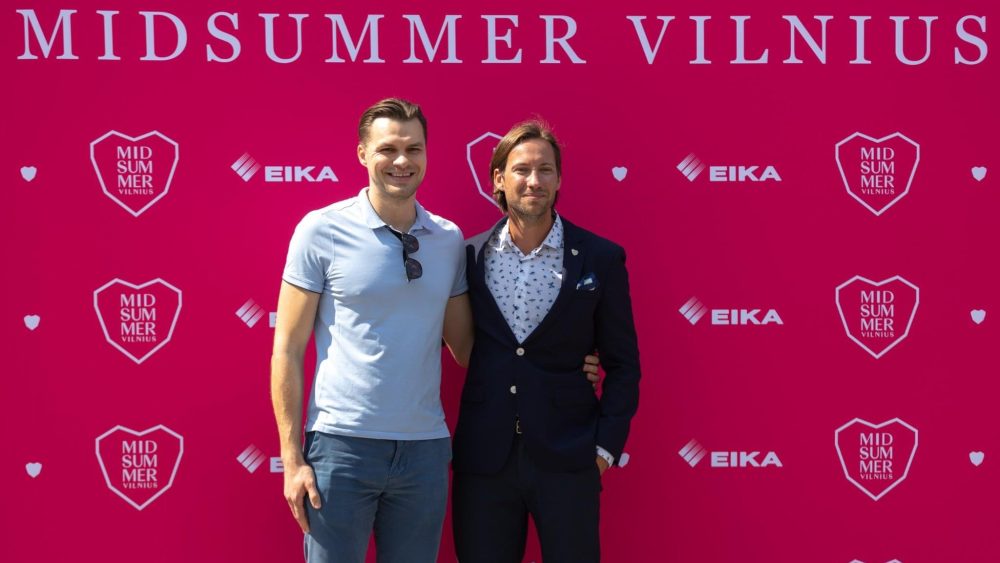
Without the support of patrons, many of the world’s most acclaimed works of art would not have seen the light of day. And vice versa – without the energy of art, cities would turn into cold ghosts made of glass and brick, notes businessman and patron Domas Dargis.
D. Dargis is interviewed by art publicist Laura Kešytė about what motivates businesses to support culture and how cultural initiatives find their sponsors.
– Let’s start with everyday things. What is your rhythm in the summer? How do you spend your free time?
– My summer consists of two parts. After the birth of children, we have a tradition of going to the Lithuanian seaside with our family – I relax and study there. And we spend the rest of the time in Vilnius.
I like city life – cycling along the Neris River, evening walks, sitting on restaurant terraces. Our old town is so beautiful and green! Concerts are fun, especially in the open air. We often visit the Botanical Garden and the Teachers’ House courtyard with our children. And in July, as is also traditional, we spend the month of Midsummer Vilnius.
– Culture in a broad sense – how much does it figure in your life? What artistic genres are interesting and relevant to you?
– Frankly, with each child (and I already have three) the amount of free time decreases proportionally… (smiles) That’s why we have fewer of those cultural experiences at the moment. But generally speaking, I really like the theater. Especially (Oscar – ed. note) Koršunovas’ performances. It’s been a long time since I had the opportunity to attend… We can currently devote most of our time to music, because the children are at concerts. (laughs)
– You’re a fan of electronic music, right? Do your tastes match those of your children?
– Oh yes, I’ve been listening to electronic music since I was a teenager, probably around fourteen. I have amassed a considerable collection of selected CDs. And I used to do remixes myself, play CDs, and play CDs. I also have a DJ console, but it’s just gathering dust now… (smiles)
Children are currently listening to Power Hit Radio the most. I don’t like everything that is played on their airwaves, but sometimes I hear something unexpected and interesting. What I can really be happy about when it comes to discoveries is Lithuanian electronic music. There is more and more of it, it is diverse, and it is of high quality.
– The company you lead has been sponsoring various cultural events for many years. What is on your sponsorship list at the moment?
– To this day, we support jazz festivals – “Vilnius Jazz”, “Nida Jazz”, “Vilnius Mama Jazz”, as well as world music cycles “Good Music Live”, which bring together performers from distant countries. Every year we support the Festival of Lights, various community events in neighborhoods. And our most prominent, most sponsored event is the festival “Midsummer Vilnius”.
– How do you choose which activities, events, and initiatives to support?
– I think that culture is an emotion. If you come to an event and feel that it is close to you, you get involved. Organically. Let’s say jazz came about because my dad (Robertas Dargis – ed. note) plays several musical instruments himself, listens to jazz, and goes to concerts.
And “Midsummer Vilnius”, when I visited, left a very deep impression with its quality, content execution, and the fact that special musical performances are created during the festival, such as “Empti orchestra”. I’m really looking forward to it, this year there will be “Fink orchestra”. The uniqueness is fascinating.
– Is the list of supported projects and events changing or constant?
– In fact, we try to include new projects, cultural or social initiatives that seem meaningful to us, but adding something extra is a kind of dilemma. Usually, when you choose something, you get attached to it. And for other businesses – similarly. For example, ERGO has been supporting “Kino pavasaras” for many years or SEB banka – “Išsipildymo akcija”.
It is not easy for new cultural and social initiatives to find a patron who does not yet have a theme. Conversely, fast-growing businesses take time to find something that matches their values and vision. You see, there has to be a mutual exchange. chemistry.
My wish is for each initiative to find its own patron, who could provide stability, certainty, and creative peace.
– What if there was no support? Initiatives would have to fight for survival solely in the conditions of a market economy?
– I think that pop would prevail, only entertainment content oriented towards a mass audience would survive. In order for high culture to be widely accepted, interesting and purchased by society, it is necessary to constantly invest in education. Compare the content created by national broadcasters and that of commercial television. The difference is obvious.
– What, in your opinion, could encourage businesses to become more involved in patronage?
– I think that a good example to follow is the corporate tax relief that has been applied to film production for some time. Lithuanian companies that want to provide free funds for the production of a film can reduce their corporate tax, and cinemas can attract funding from private sponsors.
In turn, the film industry creates a number of jobs – brands such as HBO and Netflix come to Lithuania, conduct filming, promote film tourism (which, by the way, partially kept hotels afloat during the pandemic) and provide various added benefits to the city.
The first steps have also been taken by Vilnius City Municipality, encouraging the support of high-level cultural and sports activities by applying real estate tax compensation. Perhaps only the selection principle itself seems a bit complicated to me. An appropriate team of experts is needed to assess who meets those high criteria and who does not.
In any case, the more good events, initiatives, the more visibility, international attention. Sponsorship is useful, it creates economic value. I will give an example that I remember very well.
In New York, in a large skyscraper block, where most offices are located, an installation was built that cost over 200 million US dollars. If we compare, the MO Museum in Lithuania apparently cost 10 times less.
The interactive installation, called “The Vessel,” was funded by private business. The object created a huge international attraction, contributed to the notoriety of the entire block, and became one of the most visited objects in Manhattan.
If we want a city to be a living organism, not a building made of bricks or glass, it must have active life, and culture is at the core of it all.