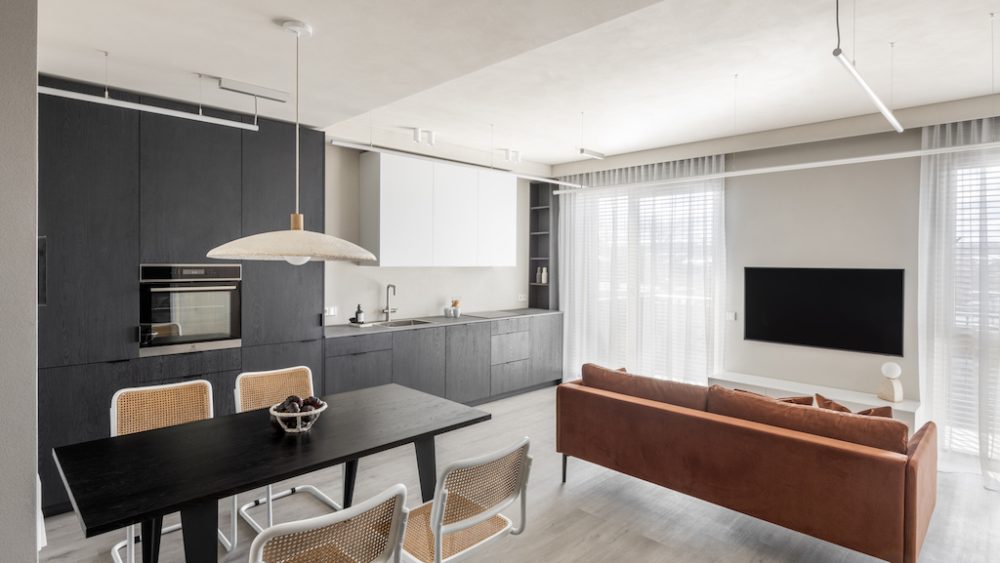
Light comes from lamps made of mycelium. The walls are covered with Lithuanian clay plaster in a calm shade. The glaze on the ceramic tiles in the bathroom walls is made of metal waste. Minimalism prevails in the interior. Used furniture is adapted for a new life. Automatically adjustable blinds and fans with integrated lamps ensure that the apartment does not overheat..
According to Domantas Tracevičius, sustainability expert and founder of Žiedinė ekonomika, these sustainable housing solutions are available now, but many new settlers still imagine them as a distant future. According to him, we can look at every investment through the prism of sustainability, and the investment in one’s own home is often the largest in a person’s life.
“Owning a home is the biggest purchase of your life. It is our choice, what kind of footprint we leave and what kind of environment we live in every day. It is not worth postponing sustainability to future generations,” the expert is convinced.
According to Tracevičius, the state has taken care of the sustainability standard, albeit minimal. Statutory regulation helps ensure energy efficiency, as newly built housing must meet the A++ energy class. However, all other decisions remain in the hands of residents.
“The cult of novelty is still very much alive – the desire to buy everything here and now, without going into too much detail about how the developer built the building, what materials or finishes were used, where they were made and how they were transported. Greater use of locally created technologies, furniture and building materials, and delving deeper into the production process of the item being purchased are those small actions that can create a big change. After all, none of us want to live in a toxic environment,” the expert says.
Sustainable housing – mission possible
Sustainable solutions can be implemented in every home. This is the philosophy of the company Eika, which has designed a model sustainable apartment. The main focus is on sustainable materials and solutions that create a comfortable life.
“We noticed that there is no uniform understanding of what sustainable housing is. Most people associate sustainability with low energy costs, and do not think about other criteria. We believe that anyone can create sustainable housing. It does not require large investments, all that is needed is curiosity and a desire to look at the housing construction process differently. The sustainable housing we have installed is an example of how the philosophy of sustainability can be applied to the environment in which we spend most of our lives,” says Maija Nikitina, head of Eika SmartLab.
In a sustainable apartment in Vilnius, many of the finishing solutions, appliances and furniture were chosen based on an assessment of the supply chain and the environmental impact of the products. Only as many electrical points and lighting fixtures as necessary for comfortable living were planned. Air conditioning was abandoned – automatically adjustable blinds ensure that the apartment does not heat up, and a fan with integrated lighting moves the air and creates a fresh breeze.
The apartment uses plumbing fixtures that have a CO2-neutral footprint. They contribute to reducing plastic consumption at home: sparkling drinking water from the tap eliminates the need for plastic bottles, and the technology in the bathroom toilet reduces the use of toilet paper.
In sustainable housing, great attention is paid to products made in Lithuania. The use of local products is one of the key principles of the sustainability philosophy. For example, the most unexpected interior element – lamps made of mycelium – was created by Lithuanian designers. And the ordinary-looking walls are covered with Lithuanian-made clay plaster, which not only creates a healthy microclimate, but is also very easy to renew.
First steps towards more sustainable housing
Experts are convinced that anyone can make their home more sustainable; it does not require large investments or exceptional knowledge.
“Our living environment is the result of our choices. If we want to live more sustainably, we must change our choices. For decoration, we can choose materials that are friendly to the environment and our health. For the interior, we can choose minimalism and durable furniture. Even better, we can reuse furniture when it is restored and adapted to new needs,” advises D. Tracevičius.
The philosophy of sustainable housing is based on the principle that decisions should be made with the future in mind. Therefore, when choosing finishing solutions, furniture, appliances and technologies, it is important to evaluate their durability.
“A simple example – think about whether if your modern lighting breaks down, you won’t have to dismantle the entire wall or ceiling. Clay plaster was not chosen by chance in our furnished apartment; it is very easy to dismantle and renew if necessary,” says M. Nikitina.
[vc_gallery type=”image_grid” images=”45678,45680,45682,45684,45686,45688,45690,45692,45694″ img_size=”medium” el_class=”zoom-in-gallery”][/vc_column][/vc_row]