The global pandemic that began three years ago irreversibly changed the labor market – in order to protect the health of employees, a hybrid work model was introduced, which eventually became almost a common request of employees in selections. This change forced not only HR specialists, but also real estate developers and managers to look for solutions, wondering how to better utilize the emptying spaces of business centers.
According to a 2022 McKinsey & Company survey, more than 58% of employees in the United States have the opportunity to work from home at least one day a week, and 35% of respondents say they can do so all workdays. Similar statistics can be found in Lithuania – according to internal company surveys published by Verslo žinios, 60-70% of employees who can do so would like to choose hybrid work.
Changes are also felt in other sectors
These shifts in the labor market indirectly affect other sectors as well. For example, commercial real estate developers and managers are having to find ways to adapt to the ever-decreasing footfall of business centers and the changing requirements of landlords to make life easier for their employees. Some of the answers are being sought by real estate developers in the digitalization of workspaces currently available on the market, which allow for more convenient building administration.
Although advanced digital BIM models have been mandatory in the construction of complex buildings for some time, the administration of such structures in the digital space is still lagging behind. Giedrius Brūzgė, Director of the Asset Management Department of real estate developer and administrator UAB “Eika”, states that currently existing digital solutions can not only significantly improve the quality of life of tenants by offering effective ways to reserve meeting rooms, car parking spaces or facilitate the reception of guests, but also help optimize the occupancy of the building manager or assess the condition of the building.
“Back in early 2021, by using digital solutions in the Eika business center, which consists of almost 15,000 sq m of commercial premises, we dramatically reduced the workload of commercial property managers and accelerated processes – which increased tenant satisfaction with the services we provide. At that time, we chose to cooperate with Flanco, which opened up opportunities to be more flexible with both business center tenants and our own employees.”
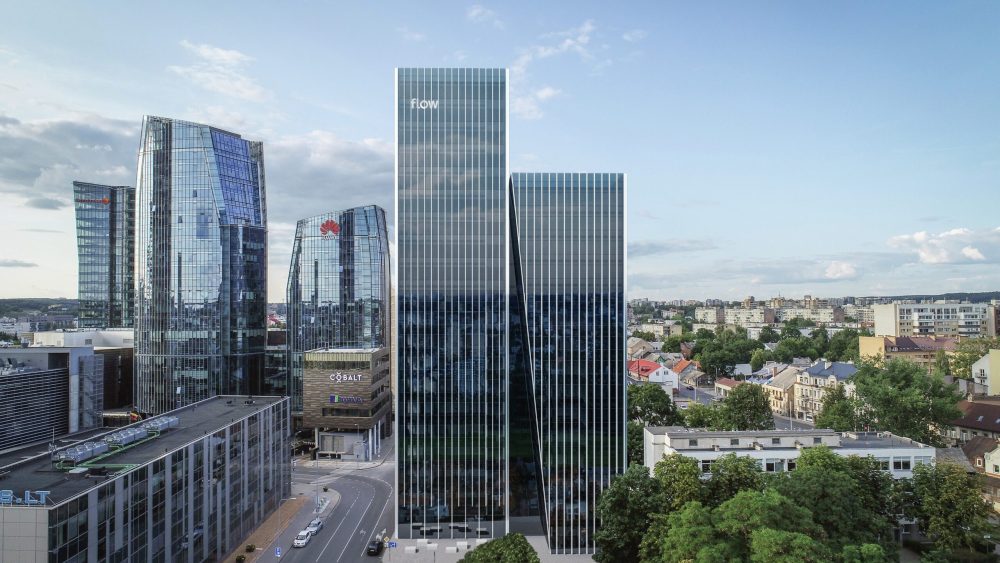
In the near future, we intend to install this system in two more facilities – Live Square (7,000 sq m) and Flow (15,000 sq m) business centers. The system provides opportunities to administer the needs of even a specific office, which is why we introduced it to the Eika office. Flanco helps us manage individual workplaces, storage cabinets, reserve them, and track occupancy, which in the long term helps us plan the needs of the office, as the team naturally grows every year and the need for space increases,” says G. Brūzgė, Director of the Asset Management Department at Eika.
Smart solutions created in Lithuania
Flanco is a smart office space management solution developed in Lithuania, allowing employees to more conveniently utilize the modern advantages of hybrid work and making the everyday life of real estate managers easier. According to Mindaugas Juška, CEO and co-owner of Flanco, both a successful employee experience and modern building administration technologies can only be ensured by thinking about smart solutions in the early stages of the project.
“Even when starting to build a building, it is extremely important to think about the right infrastructure, the selected technical equipment and plan the movement of employees in the building. Your employees should not waste time thinking about parking spaces, access to the building spaces, receiving guests or reserving meeting rooms. Real estate should not be chosen based on the area of the roof terrace or the number of parking spaces, therefore, we currently offer real estate managers a modern approach to building administration focused on the employee and his comfort. In the current market, it is extremely important to assess the abilities of real estate managers to effectively adjust processes and use available data in real time, ensuring a smooth employee’s day,” says M. Juška.
Tenants take decisions into account
The value of smart solutions is also emphasized by tenants. Elektrum Lietuva, one of the leading energy companies with almost 300 employees, most of whom work in a hybrid mode, announced in December last year that it would locate in the newly emerging business center Flow. The company’s CEO Martynas Giga emphasizes that the effective organization of hybrid work and convenient planning were one of the arguments for choosing this business center.
“We are growing and developing at a rapid pace, so the space in which we work must evolve with us. We simply “outgrew” our current office, and in search of an opportunity to create comfortable and modern working conditions for our rapidly expanding team, we chose the business space “Flow” as our new headquarters. It was important for us to create an ergonomic working environment there that would meet the changing needs of individual and team work. We are used to working on the principle of hybrid work, so we will apply it in the new office, continuing to use the office management and seat reservation system “Flanco”, which has already proven itself to us,” says the head of “Elektrum Lietuva”.
According to Giga, it is now noticeable in the labor market that employees themselves increasingly value the flexibility to work both from home and from the office. According to him, the new principle of hybrid work organization is forcing organizations themselves to reorient themselves – it is no longer effective and meaningful to invest in the same number of workplaces as there are employees – now investments are directed more towards effective work organization and convenient planning.
“Flanco helps us conveniently organize a hybrid work model, plan our work in the office, because through this system we easily reserve our work and meeting places, monitor their occupancy, and share them with colleagues. At this stage, it also helps solve the challenges of rapid team growth, because the same workplace in the office can be conveniently shared by several colleagues by taking turns,” says M. Giga.