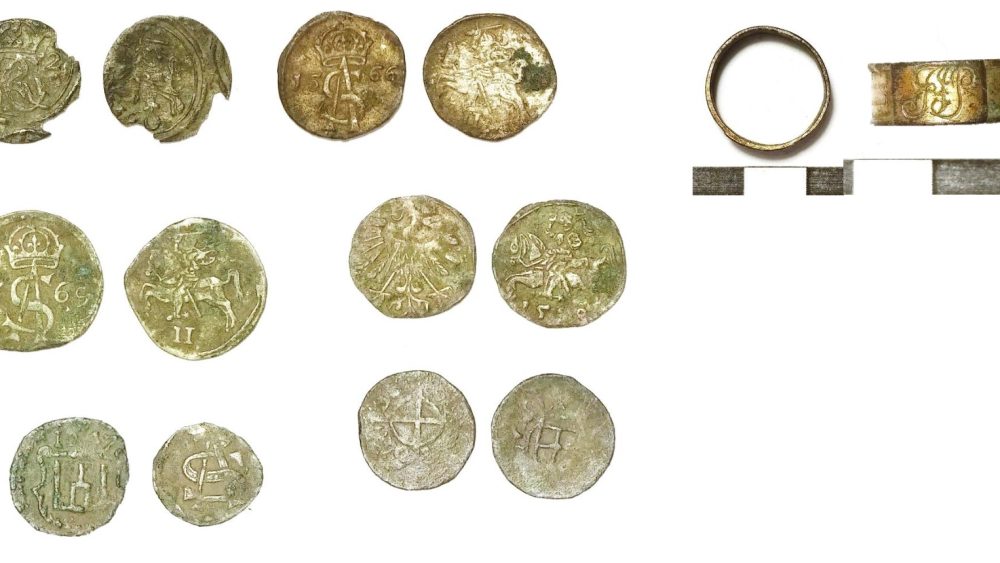
[vc_row][vc_column][vc_column_text]Coins minted in the late 15th and 16th centuries, fragments of household ceramics of the time, parts of kiln tiles, small 17th-century–18th century archaeological finds. This was discovered after archaeological surveys and detailed research on the plots of land at 33 and 35A St. Stepono St. in the capital.
The 1700 sq. m area was thoroughly investigated before co-living apartments were started.. co-living) Construction of Solo Society City House Vilnius and the residential housing project St. Stephen’s White Sheet, which are being implemented by Eika.
According to the archaeologists who conducted the research, the coins are the oldest finds discovered during the research – they are dated to the end of the 15th century (a half-penny of Casimir Jogailaitis, a forgery of a half-penny of Jonas Albrecht). However, only a few such coins have been found. It is believed that at that time people did not live in this territory and there was no intensive economic activity. This is also confirmed by the historical outline of the historian Rasa Dičiuvienė.
In 1503, when Prince Alexander ordered the construction of a defensive wall around the city, this territory became a suburb, i.e. a suburb began to develop in this place, called Rūdninkų or St. Stephen’s. The defensive wall gate – Rūdninkų, in the immediate vicinity of the territory was built in 1522-1550. It is believed that during the same period, in the 16th century. 1st century, the street through the gate was also formed, leading towards the prince’s estate.
St. Stephen’s Street from the 17th century.
The role of the Rūdninkų Gate was very important – the most honorable guests of Vilnius: kings, voivodes, bishops, entered the city through this gate. According to the archaeologists who conducted the research, the largest number of coins and other household ceramics found in the studied area were found in the 16th century, during the reigns of Alexander, Sigismund Augustus, Sigismund Vasa and John Casimir.
Even more active life in the aforementioned territory began in the 17th century, when in 1600. on one of the hills, near the street route, the construction of the brick St. Stephen’s Church, the wooden St. Lazarus’s Shelter and a new cemetery were opened nearby. After the spiritual center was established, the part of the street from the Rūdninkų Gate to the church began to be used even more intensively and was named after St. Stephen.
According to archaeologists, the majority of archaeological finds discovered during the research date back to the 17th-18th centuries. According to Justina Dobeikienė, Deputy Director of the “Search for Cultural Values”, archaeological research is the only way to learn about the daily lives of people who lived in the past.
“The first written sources are quite late, and even when they appeared, they do not describe simple everyday life and household life. From the cultural layers analyzed during archaeological research and the finds found in them, it is possible to learn how people lived, ate, decorated themselves, and how they furnished their homes. For example, the found fragments of household utensils and parts of stove bricks allow us to judge the financial situation of the people who lived here, and the discovered animal bones reveal their dietary habits,” says J. Dobeikienė.
A piece of history will be applied to a new project
According to representatives of “Eika”, the coins found during the research were transferred to the Numismatics Department of the National Museum of Lithuania, while special and other finds were transferred to the Department of Medieval and Modern Archaeology.
In the territory of Šv. Stepono gatvės 33, 35A, more than 2000 sq. m of unhewn stones were found, which were used to lay down rain gutters and paving around mid-20th century buildings, which were probably workshops. It is believed that they were laid around 1941–1943.
“Although from an archaeological point of view, uncut stones are not of historical value, we found this find interesting. In addition, its volume is quite large, so the team had the idea to use these stones again – in a new project,” says Martynas Žibūda, Deputy General Director of EIKA.
Several thousand stones have currently been removed for storage, and later, upon completion of the project on Šv. Stepono street, it is planned to bring them back and pave the pavement around all three building blocks. In this way, the company aims not only to sustainably reuse old building materials, reduce the amount of new materials, but also to leave a piece of history in this place that the new residents could see every day.
Currently, the construction of the shared living apartments “Solo Society City House Vilnius” and the housing project “Šv. Stepono Baltas lapas” is underway. During the project, four- and five-story buildings will be constructed, which are designed to have 269 hotel rooms, 117 apartments and 15 commercial premises on the first floors. The completion of the project is planned for 2023. II quarter.
[/vc_column_text][vc_gallery type=”image_grid” images=”44407,44409,44411,44413″ img_size=”medium” el_class=”zoom-in-gallery”][/vc_column][/vc_row]