Last year, the company invested EUR 26.4 million in project development, or 41% less than planned.
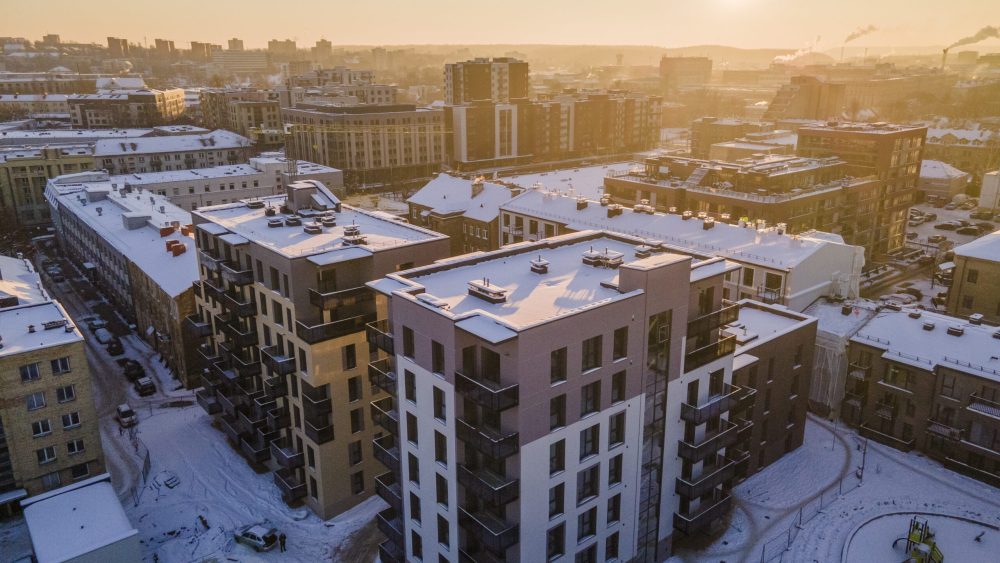
This year, the company will invest mainly in Vilnius (EUR 36.4 million), directing most of the funds to the housing segment – EUR 25.2 million, and another EUR 13.4 million has been earmarked for the development of commercial real estate.
The company will also direct investments to office building “Flow” next to Konstitucijos Avenue and to the construction of a store in Pilaitė, to the expansion of the building “Eikos Business Center”.
“This year, we want to start the projects we intended to build in 2020 as soon as possible. In addition to the aforementioned housing projects, the construction of which will begin soon, the Flow office building project is also important to us – we hope to receive a construction permit in April and, if there are no cataclysms, it will begin in the second quarter,” says D. Dargis.
In an interview with VŽ, D. Dargis tells how he managed to survive the pandemic years, which halted the development of some of Eika’s projects, and why he does not plan to sell a hotel in the center of Vilnius and start building logistics facilities.
How did you do last year, during the pandemic?
We did not rush the development ourselves, but due to the changed position of the municipality, we had to publish some projects and design proposals more than once, coordinate them, we constantly received comments and new conditions, departments did not agree on what to require of us, new commissions were established. I would dare to say that this extended the design process by 3–6 months.
2020 was a year of transition. Now it is a little clearer how to work with the municipality. Although the people there have not changed, the procedures have changed a lot.
Maybe this way the projects only become better?
Maybe. I think our projects have never been bad. And in general, the quality of projects in Vilnius is improving. However, it would be good to know the expectations so that they are named and timely, and not constantly crushing innovations bit by bit. Sometimes you don’t even know what to do.
How has the pandemic affected your business?
You were probably one of the first in the market to react to the coronavirus crisis and take real action when many were just waiting to see what would happen: you stopped projects, offered buyers certain guarantees. Did these steps work?
Pausing new projects helped us accumulate funds for other projects already under construction, such as the Baltas Lapas quarter or the development in Pilaitė.
As for buyers, we signed such contracts due to the guarantees offered, but there were few of them, probably up to 10. However, after that, the general background on the market changed. So the effect of this decision was indirect, but at that time the market needed it.
This year you intend to expand your community housing portfolio and you are the ones with the most experience in this segment. How do you assess the situation now that more and more market participants are interested in the segment?
In Kaunas, we have invested in student Solo Society dormitory project, in which we are currently installing over 30 more rooms and we will already have more than 270. So, a small expansion is underway in Kaunas. The project planned on Vilnius’s Šv. Stepono street also includes 70 such rooms. We will be able to offer them as we move towards opening in 2022.
We do not treat the units in this segment as housing, but as rooms that are an integral part of the entire project. We design these projects in such a way that they cannot be sold as separate apartments, as there are many common areas, services and it would be difficult to change the premises for another purpose. Such projects would be easier to convert into hotels than into apartment buildings.
I think the main question will be how big this market is. For example, in Kaunas I don’t hear about such projects anymore, but in Vilnius there are a lot of them planned, although there are more foreign students studying in the temporary capital than in the capital. So I wonder what will happen here.
Perhaps now the hopes are placed on young professionals, for example from Belarus. In Vilnius, the market is a bit different, because in Kaunas, there are no young professionals living in our projects – 100% of the population are students.
For example, Inreal estimates that 1,400 such homes are currently planned in Vilnius. Isn’t that too many?
If we were to only take students, that would be enough. Considering the audience of young professionals, the potential is 500 visitors per year, so there is definitely room to offer more.
What are the developers’ sentiments regarding housing?
This is probably the hottest of all real estate segments at the moment. I did not expect such a quick recovery and stability, the opposite effect to what was expected, for prices. I thought they would not fall, but they grew very strongly by segment. In general, about 5-7% per year, but in individual projects there were 10% or more. This is a completely unexpected effect, but it has happened in many places in the world: in Germany, Denmark, in the US housing segment.
It was a surprise to everyone, so there was not enough housing on offer. And I’m not sure if we will be able to offer it any time soon, even now with all the restrictions and the complexity of getting a building permit.
Now, not only does the design process take a very long time, but the situation with plots is also complicated. The issue of renting state land was not resolved during the previous government’s term, it is still pending. This means that half of the plots on the market can be written off as potential for development, although they are usually located in good areas of the city. And the owners of the rest feel the market situation and try to use it.
Tell us about the office building planned on Konstitucijos Avenue. Have you built anything in the central business district?
As for class A offices, they first took shape on the Neris embankment, where we built the “Business Triangle”, and Konstitucijos Avenue appeared later. And yes, this is our first project here.
The concept of this project is not related to COVID-19. Even before planning it, we thought that employee well-being would be increasingly important when choosing an office. The pandemic only reinforced this, as the aspect of health and safety contributed to that well-being. But the trend remains: employees increasingly dictate managers’ decisions when choosing an office.
So the location of the office may be important to the manager, but what the office will be like is most important to the employee.
Until now, when it came to certification, people were talking about LEED or BREEAM – now almost all projects are choosing this path.
The first steps are being taken towards wellness and new certification systems are emerging, which will probably become the norm in the long run.
We will ask the operators in the building to focus on healthy food, there will be a salt room to improve health, maybe massages. There are already companies on the market that take care of such things themselves. We will become the operator so that they don’t have to think about it themselves. They will be able to use the common infrastructure of the building.
You mentioned that you made a decision last year not to start the office expansion until you had tenants. Perhaps you are already negotiating with them or have signed contracts?
We don’t have any contracts, although there is interest.
The supply of offices is currently large, there is a lot of choice. Owners of older buildings need to invest more and renew, improve services, infrastructure. We are doing this in our “Eikos Business Center”, otherwise clients will ask for discounts or we will lose them.
One of the tenants of our complex wanted to expand, and that’s when we came up with an expansion project, but unfortunately we couldn’t agree on the terms. Since we had done the work, we decided to finish it. We took the opportunity to hang a connector above the car park on the 4th-5th floor, connecting both buildings. By connecting these floors, we will be able to offer the market more than 1,500 sq. m. per floor. And there are companies that need it, because until now we could offer 550 sq. m. per floor.
Another aspect is the increasing popularity of terraces, now almost all new buildings have them. This is no exception, we are planning a green garden and terrace on the roof of the connection, open to events and tenants.
In 2019, you opened the Live Square complex near Lukiškės Square. As I understand it, the offices there are doing well, but what is the situation with the hotel?
A complete roller coaster: the hotel was not operating at all at one point, because during the first quarantine, foreigners were banned from entering Lithuania, and they were our customers. In the summer, there was a recovery, although I wouldn’t say it was big, but the hotel was able to generate positive cash flow. The so-called Baltic bubble helped us with this, when guests came from surrounding countries. In the fall, the situation was still somewhat bearable, and now even arrivals from other cities have been stopped, when we had already tamed customers from other cities for weekends and the like.
Now we receive income from long-term foreign residents who have come to Lithuania for work. Sometimes there are also various series being filmed or commercials. So the clients are either those who have come for work or Vilnius residents who have dinner and stay with us. Our results are better than the market, but the hotel is currently struggling to survive. It will be a real winter.
We have a franchise with Hilton, so all the employees work for us. Last year we received compensation for downtime and wages – there was some help.
Hilton itself is saying that the recovery will be rapid, which may sound overly optimistic. Perhaps this will happen in markets where the pandemic is under control and tourism is recovering, such as in Asian regions.
I don’t think 2021 will be such that we can talk about any plans. The most important thing for us now is to maintain the team, because it is very strong.
How long do you think the hotel segment can survive in such conditions?
We can hold out for a long time, but probably not everyone can, because other hotel owners do not have other sources of income. Our group is quite diversified, earning from various businesses. For example, in the case of the Live Square complex, we can cover the bank loan from the office rent, because we have not borrowed much.
From the ongoing transactions in the hotel segment, which were not there before, we see that there is a lot of stress. It seems that there will be more of those transactions and the hotels will pass into stronger hands, to owners with bigger pockets.
Are there anyone willing to buy hotels in the market at this unfavorable time?
Yes. We probably won’t be active on this unless we look at it opportunistically. But there are strategic investors who want to go into this segment and can wait. I think they are definitely in talks with a number of owners.
Would you consider selling Hilton yourself?
No, there were no such thoughts.
Last year you also entered the logistics segment: you agreed on DHL logistics terminal construction near Vilnius airport. Do you have any further plans?
We are really interested in logistics and are negotiating with a number of companies that need such buildings. This is a segment that we are exploring a little. We also offer our own plots, because we manage the Vilnius Industrial Park, free economic zones in Šiauliai and Kėdainiai, but we have also offered territories in Kaunas and Klaipėda, because we have agreements with landowners.
These could be objects with an area of 5,000–50,000 sq m, so that the risk is still acceptable.
There are even such competitions, for example, we participated in in the purchase of window manufacturer Rehau. Both local and foreign manufacturers and logisticians are interested in such facilities. Their development is not related to the pandemic, which only affected the parcel business very strongly and its demand for terminals grew very quickly. We do not feel that it is decreasing, which perhaps means that a change has occurred in the market, which should have happened in 5-7 years.