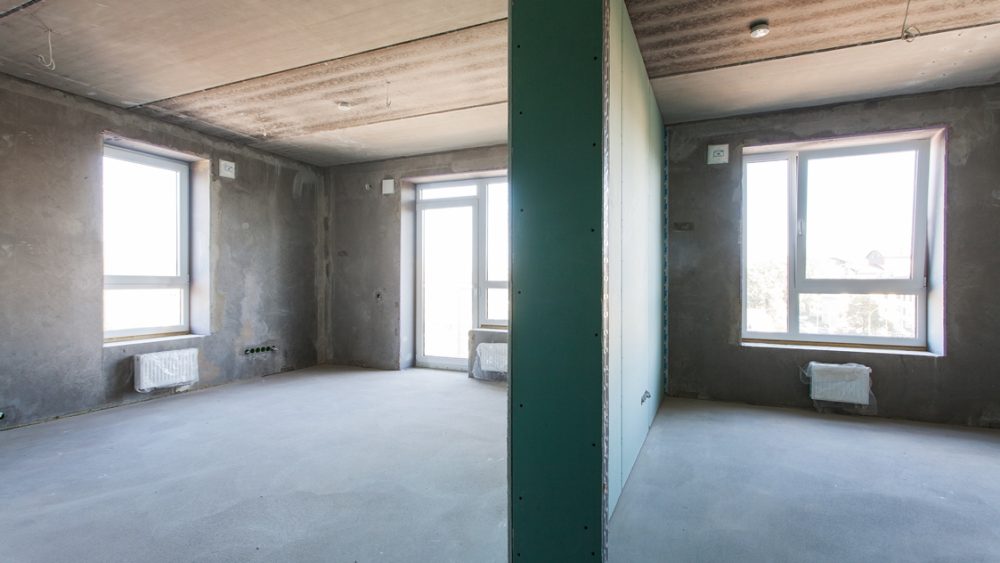
Partial finishing of a home is usually perceived as “more than bare walls”. However, what exactly it should consist of is not defined in any document. So this opens the door for real estate developers to juggle various concepts, hide unfinished work, and the buyer, having purchased a cheaper apartment, can later spend a significant part of his savings on additional installation work.
Home finishes are usually divided into three main levels: “no finish,” “partial finish,” and “full finish.” It is the concept of partial finish that raises the most questions, and buyers should carefully study the description of the partial finish.
“Partial finishing has long been understood as an apartment with partitions, plastered walls, electrical and weak current points in the places provided for in the project, in the sanitary unit and kitchen area, and pipelines that are brought to the places of sanitary appliances. Partial finishing also included a ventilation system, if it was provided for in the project and is necessary in order to ensure the energy class. True, in the last few years, project descriptions have included “full partial finishing”, “incomplete partial finishing” and similar terms,” says Kęstutis Taletas, Head of the Design Management Department at Eika.
According to the expert, the description of partial finishing is like the “technical specifications” of the housing, according to which the buyer can compare different apartments. “The first step for the buyer is to critically evaluate the description of partial finishing. If you lack competence, consult with relatives or colleagues who are knowledgeable in the field of construction, or rely on a competent sales representative,” advises K. Taletas.
Most often, reliable companies that complete the work to completion provide all information online, describe in detail all the advantages of partial finishing, thus openly showing the buyer what product they will purchase.
Comparison: Why is lower price not the main criterion?
According to an Eika expert, after a critical assessment of the partial finish, the buyer’s next step is to understand what makes up the higher price of a home and why the “lowest price” criterion should not always be followed.
“Imagine that you have buildings of identical shape, standing opposite each other on the same street. And you can’t decide in which one you want to buy an identical 50 square meter apartment. Both are partially finished, only apartment A costs 95 thousand. EUR, and apartment B – 85 thousand. EUR. The price difference of about 10 percent is significant, and this may even determine the decision to purchase a cheaper apartment,” says K. Talet.
True, the rooms of the more expensive apartment A have internal plasterboard partitions, and in the sanitary units – brick partitions, sand concrete floors with plaster waterproofing are installed, an individual ventilation unit with recuperation, air supply and exhaust points are led into the rooms, pipes are brought to the location of sanitary appliances and are terminated with device elbows, to which you can immediately connect your washbasin, bathtub, other sanitary appliances and household appliances. Cables are led to the final points and terminated with mounting boxes. For comparison, in apartment B there are only pipes in the sanitary unit and kitchen area, an outlet to the sewage stand, and an introductory electrical and communication panel.
The expert suggests calculating how much time and money will have to be invested in apartment B so that it can be equal to apartment A in terms of equipment and decoration.
“So installing internal partitions will cost about 1,900 EUR, pouring the floor in the sanitary unit – 500 EUR, a ventilation system with balancing works – 2,400 EUR, bringing water supply and sewage to the final points with deepening and plastering of the pipelines – 600 EUR, installation works of electrical points – 1,800 EUR. So, all the additional work can cost about 7,200 EUR. Of course, one should not forget that in addition, the entire work process will have to be supervised, 3-4 separate contractors or foremen will have to be hired, and the work will have to be checked to see if the work has been done properly. And only after these works will the buyer be able to invite an interior decoration contractor,” says the housing design expert.
He estimates that the buyer of Apartment A will move into their new home in about 3 months, and the buyer of Apartment B will move in after a stressful and difficult 5-6 months.
So, in summary, when buying a new home, it is very important to properly assess the completeness of the partial finishing, compare the product not only by price, but also by its specifications, just like you probably do when buying a new mobile phone. Write down all the pros and cons in a table and calculate how much additional time and money all this will cost you.
“The initial lower price of an apartment can be deceptive and later cost unplanned investments and time costs. Problems may also arise later due to warranty obligations, when the resident himself is responsible for additional work, and not the seller, who sold him a partially furnished apartment. So before buying a home, compare not only prices, but also partial finishes,” advises K. Talet.