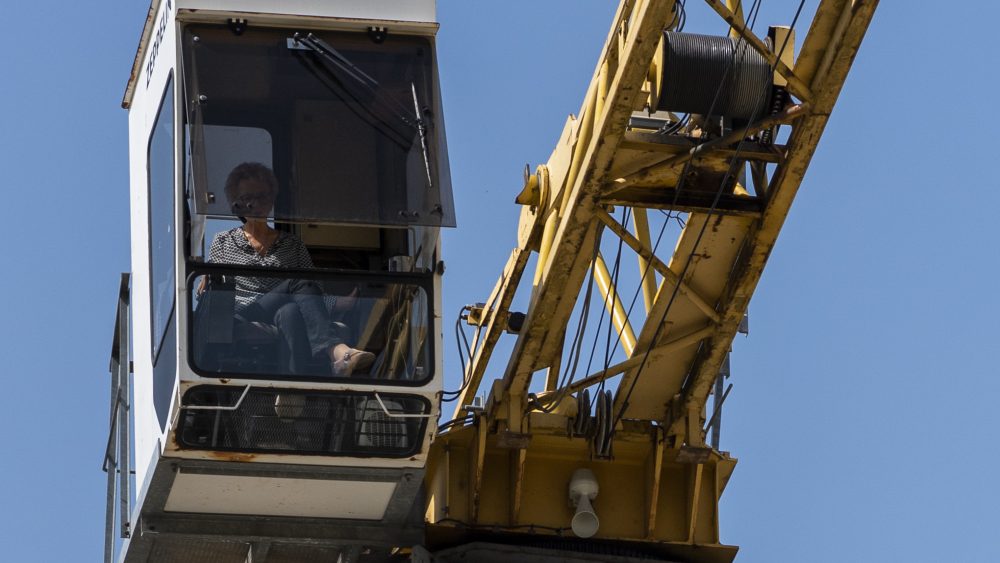

Every morning at work, she climbs a ladder to a height of 30 m. Not to constantly admire the panorama of the capital Antakalnis, although that is part of her job. Violeta Janovič has been working as a tower crane operator for 11 years.
“This tower crane is still relatively low. I prefer it higher up – when the building grows, visibility is better from a higher crane, and now it’s almost level with the house,” the woman smiles. Violeta has long forgotten her fear of heights, and she’s also gotten used to the fact that the crane swings. Only those around her are still surprised when they see a woman sitting at the wheel of a tower crane and deftly controlling a giant device. “I don’t know if this is a man’s job. You’d better ask the construction workers. I really like this job,” says the crane operator.
Fear of heights evaporated
Violeta turned to the construction industry in 2008, driven by a desire to earn more. After the painful loss of her husband, she had to take care of her daughter alone, so naturally she had to look for a better source of income. “While working at a store, I read an advertisement in the newspaper that crane operator courses were being organized. I called, talked, and they promised a better salary than I was receiving. Not mountains of gold, but still more. I got along well with the buyers, but after three months of deliberation, I decided to turn towards construction. I wrote an application for the courses, although I doubted whether I would be able to operate a crane,” the woman recalls. Violeta was very afraid in the first days – as soon as the crane started to swing, she would grab the railing inside. Later, she realized that when placing a heavier load or pulling harder, this was inevitable. In addition, she was afraid of making a mistake and injuring her colleagues working below. But with experience, that fear evaporated. According to her, people still ask in amazement how she manages to climb those skinny ladders onto a tower crane. “I say I got used to it. Sometimes you have to climb up and back down more than once a day – so you go down and have lunch and stretch your muscles so you don’t sit for too long,” says the crane operator, who is currently working on the “Antakalnio panorama” project being developed by “Eika”.
I was drawn to technical things.
Every morning from 7 a.m., the woman who already operates a crane says that her job requires precision, good reaction, and logical thinking. Before starting the courses, she thought that the skills she showed at school in operating machinery would come in handy. “I graduated from school in Soviet times, where we had to disassemble and assemble a machine. I did it the fastest in class. So I thought that I had the reaction after all. My math grades were also among the best, so my logical thinking is probably not bad. I’m really happy that I went to the courses and ended up in construction,” admits the crane operator at Baltic Cranes Logistics. Her daughter is also inclined towards technical professions – she was the only one among the twelfth graders to graduate with a top ten in physics. According to Violeta, her daughter could disassemble and assemble a computer – it wasn’t a problem for her. “She wasn’t really surprised that I was going into the construction industry, and she always supported my decision,” Violeta appreciated her daughter’s approval.
Enjoy the city panorama
When she has a free minute, Violeta takes advantage of the unique opportunity to admire the city and its panorama. “Sometimes the materials are late. While I’m waiting, I obviously look around the area. I compare which houses are old and which are new. In Antakalnis, this can be done and the difference is obvious,” says the crane operator. When asked if she could call her job romantic, Violeta smiles: “Any job, if you like it a little, can be romantic. And if you don’t like it, you won’t find any romance in it.”