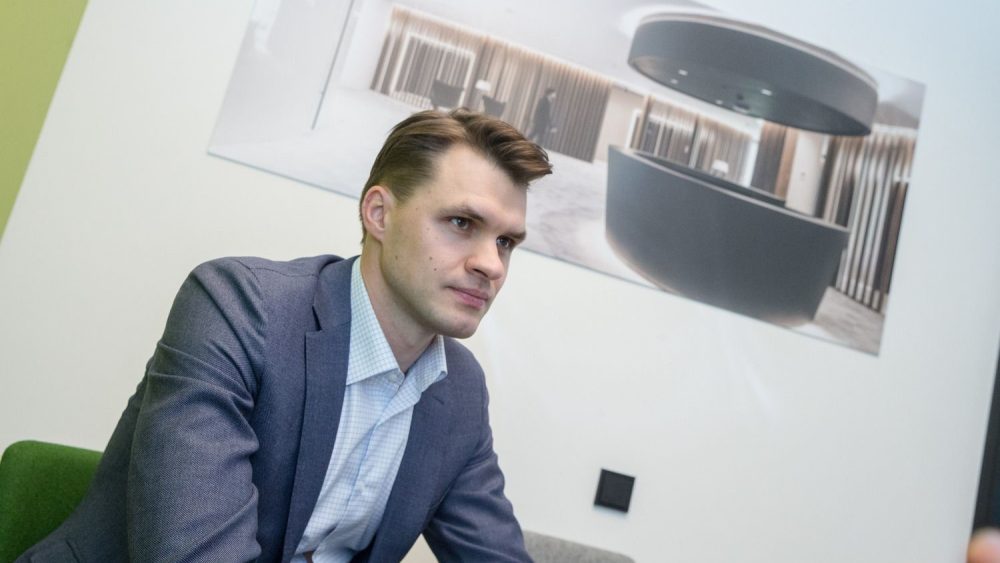
Competition in the Vilnius housing market is intensifying, which poses challenges for developers, says Domas Dargis, CEO of the construction real estate (RT) development group Eika. In an interview with VŽ, he assesses Eika’s results achieved last year, the state of the Baltic real estate markets, and urges developers to let contractors breathe.
You are optimistic about both commercial and residential real estate development. How do you feel about the housing sales data from the beginning of this year? Some analysts say that the peak has been reached, and we will have to come to terms with the new reality.
But that’s enough for us. The market size is enough for us. Of course, we want growth, but if it stays at the same level as in 2017, it’s still better than in 2015.
Let’s not consider 2016 as a model period, because then the growth was huge, in Vilnius – double-digit. Yes, housing sales have decreased in Vilnius now, but in Kaunas they have increased. So, there is potential. Maybe someday large companies will come to Kaunas and Klaipėda, and the attitude towards the port city will change. We are finding where to invest in the housing market.
Of course, it is necessary to understand that the macroeconomic situation on a European scale is too optimistic, towards euphoria. The economic situation of European countries will inevitably affect us as well. Therefore, the risk is: we do not know when something may happen.
We can only take measures that will help us respond to changes faster. For example, if we are building a block, we do not build 600 apartments at once, we build one hundred at a time. Also, we have not invested much in plots now, unlike in 2007, when we had to buy plots for ten years in advance. We have such blocks that we have been managing since 2006-2007 and have not completed them, for example, in Bajorai. It was purchased in 2006, and currently we are not halfway through developing it.
I understand that the city’s priorities are in the center. We are also focused on developing more projects in places where infrastructure is being improved better than in the countryside. In addition, clients also prefer the city center or surrounding neighborhoods.
Do you see any signs that housing prices may fall this year compared to 2017?
In individual segments, in microdistricts – it may, especially where there is a lot of competition. However, I would not say that it will fall, rather it will not grow. Now the conditions of banks, interest rates are not high and it is not very expensive to keep the built apartments.
We, like others, are building gradually, not in blocks, so the capital is not so frozen that it would be necessary to sell as soon as possible. Prices may stop and not grow, discounts may be applied. However, I do not see them falling en masse, unless bank money suddenly starts to become more expensive, then it may be different.
As for areas closer to the city center, on the contrary, price growth may accelerate. Because there is a shortage of plots, if a project does emerge, its prices will be higher than the previous one. So I don’t see any stress about pricing.
Maybe smaller developers can get stressed?
There is always more stress for the smaller ones. Sometimes they borrow at high interest rates, not necessarily from banks. But they do not reach such a scale that they can influence the entire market. Their scale is too small to cause a wave of discounts. 5 companies in Lithuania probably have about 40% of the housing supply in Vilnius. This is a big influence.
How did Eika do last year?
In 2017, we completed the reorganization of the Eika group structure. We separated the companies that manage assets and have loans from Eika. Eika itself has no debts at all, it manages assets that are not pledged to the bank. It becomes a very low-risk, unconstrained company that can invest, lend, and guarantee companies without being restricted by banks. This has made life easier – we can make investment decisions faster.
The reorganization was crowned by Eika Asset Management and the funds it manages. We are becoming minority investors, we are more of managers. This is a transformation that is currently taking place both in our group and in the market.
How was the last financial year?
Good. In 2016, we had very good housing sales, which turned into notarial contracts in 2017, significantly adding to turnover.
Last year, we also sold the business center “135”. This transaction significantly changed the financial indicators. But it is, let’s say, a one-off, so it distorts the results a little, of course, for the better.

What do you see for this year and 2019?
We didn’t launch many new projects in 2017, so 2018 will be better. Last year, we failed to acquire suitable projects with manageable risks, we didn’t want to buy expensively – we are investing cautiously.
As for preliminary contracts, the situation will be better this year, and the income will be reflected next year. Therefore, I do not think that we will break records this year. Perhaps the share of “Eikos statybos” will increase, because they started the year quite successfully.
Challenges are increasing. Already in 2017, we felt strong competition, many developers and projects are emerging. The number of apartments offered in Vilnius is increasing. In Riga, we are looking at opportunities to develop both dormitories and housing and commercial real estate.
You mentioned that Eika is increasing its focus on the central part of Vilnius. Do projects in the center or the Old Town not have additional difficulties?
There are risks everywhere. The difference from other districts is perhaps that the center or the old town is quite densely built-up and there are residents who are sensitive to construction. But legal risks, such as anchors or National Land Service (NLS) scandals, can happen anywhere. It may be slower and more difficult here, but if you manage to develop in the center, there is an advantage.
“Eika” does not develop projects in the Old Town, but there are areas or buildings with certain valuable features in the New Town. What is the relationship between developers and cultural heritage stewards?
We still believe that there are no clear rules from the Department of Cultural Heritage (DCH). For example, how they treat buildings, zones, height. We feel that those decisions are greatly influenced by moods and personal opinions.
However, if clarity means that nothing can be done, that’s also not right. Because that’s self-deception: if we restrict everyone, nothing will happen. That won’t happen. Something will still happen, it will turn into illegal construction, people will start getting caught. I would say that would be an unprogressive approach.
I think it’s better to give freedom, but have clear guidelines on what is possible and what is not. As for the Old Town Special Plan, I would like to strongly revise it. You can’t stop the development of the city – the city is changing.
You say there are no clear rules. How do developers communicate with the KPD? How do you communicate?
So you tell me how to communicate. You know, we take a very big risk. We follow their decisions. Here, like the courts, whose decisions sometimes contradict each other. But there is a position emerging, decisions. Based on them, we assume that they will be repeated in the future. But this does not always happen.

How do you evaluate the capitals of the Baltic States from your perspective?
Different speeds. I would rate the Tallinn market as the hottest. It is small, but has a lot of participants. Both the housing and commercial real estate market values exceed Vilnius. In my opinion, they are inflated. Also construction prices.
We also don’t find small properties attractive. When entering such a market, you need to have a lot of them to make it worthwhile to be there. Developing one property at a distance would be expensive. We could only be financial investors, but there is no shortage of such in Tallinn either.
As for Riga, it is the last such recovering market, I would say even Kaunas seems a bit more active in the office market. Riga could have more and more interesting projects.
So you see more potential in Riga?
Yes, there is a lot of potential there. Akropole will shake up the retail market, I think there should be office projects that would do the same. Maybe the Lords LB Press House project.
And we are looking at what could move the housing market a little. So we see the most untapped potential in Riga. The problem with Riga is that it is an aging city. There is a lack of young people here: it seems like there are a lot of students, but then they move somewhere.
Vilnius is still growing in this sense, the number of young people is increasing. The city is getting younger, and that is good, right now I would write all the tens for Vilnius, because growth is already there and there is still potential. Maybe it won’t be like this all the time, but right now Vilnius is winning this competition and we are happy that we are investing the most here.
We are also looking at various projects in Kaunas. And offices, although many are still under construction at the moment. But so far those buildings are filling up quite well. As was the case in Vilnius: 200,000 sq m was built in a couple of years and there are no empty buildings. High-quality supply generates demand – companies are bolder going to cities where there is space to expand. We see potential in Kaunas for both commercial and residential construction.
In Kaunas, you wanted to undertake an investment project on Laisvės alėja, on the site of the former shopping center “Merkurijus”, but you backed out.
There were plans. At that time, the situation was perhaps a bit complicated. Now there will be a competition, we do not rule out that we will return. Let’s say that we are potential candidates. The location is good, the project is interesting, we will consider it.
What are the biggest problems in the construction and real estate sector at the moment?
The uncertainty hurts all the time. We still don’t have an answer on how the leased state land will be treated. Already in 2017 we have refused more than one transaction. This freezes more than one plot. Large plots in good locations, because plots in city centers are usually state-leased land.
This is also a problem for the development of the state, because indecision can harm the state’s reputation, there are foreign investors who refuse to make deals. The emotion is so overwhelming that the legal situation and ownership are unclear.
For investment funds, which have a huge selection and do not manage their own money, the unclear legal situation is taboo and they simply do not consider it further.
What is the situation in the construction business?
The biggest problem here is profitability. The construction business is practically unprofitable or very low-profitable. We have a company whose profit is absolutely minimal. The overall profitability of the sector is minimal.
This is a huge risk. Here is an example from England, where one of the largest construction companies went bankrupt. Of course, this is also a problem for developers – any large builder can go bankrupt, and you don’t know which one, and the guarantees disappear. Working with minimal margins is playing with fire, because it can cost the company.
Then companies go into the shadows?
Yes, there are small ones that work with individuals. There is another risk here – you can be closed by the Tax Inspectorate. I don’t wish that on anyone.
I would say that there needs to be more sustainability. Maybe when choosing a contractor, I would advise everyone not to look at the lowest price. It is better to assess the situation of the companies, the competences of the people – you can pay more for that.
Of course, the public sector is constrained. However, I would advise the private sector not to pressure contractors, to let them breathe. Too much pressure and sometimes inadequate pressure leads to failure, and then that wave spreads to everyone.
Would you agree that it would be established at the level of legislation that new housing can only be sold with full finishing?
Yes. But I think that without a law, we will switch to such a model ourselves. We are also educating the market, trying to show that this is not a high price – we ourselves do not earn much from it, we cover the management costs. However, we can get materials at a good price, we give a guarantee, which is also important. I do not rule out that in a few years all the apartments we sell will be fully finished.